1代数Algebra
部分分式Partial fractions
1) 必须从真分式出发:即分子的次数必须小于分母的次数。
若不是这样,就必须先做长除法,求出商与余数。
2) (a) 线性因子(不重复)
(b) 线性重复因子(带平方)
(c) 二次因子)
或
Example:Express 5 − x + 2x2(1 − x)(1 + x2) in partial fractions.
Solution:The degree of the numerator, 2, is less than the degree of the denominator, 3, so we do not need long division and can write
注意:x 可以取任意值,因此总能得到足够多的方程来解出 A, B, C, D . . . .。
Example:Express x2 − 7x + 22(2x − 1)(x − 3)2 in partial fractions.
Solution:The degree of the numerator, 2, is less than the degree of the denominator, 3, so we do not need long division and can write
Example:Express x3 + x2 − 9x − 3x2 − 9 in partial fractions.
Solution:Firstly the degree of the numerator is not less than the degree of the denominator so we must divide top by bottom.
Factorise to give x2 – 9 = (x – 3)(x + 3) and write
2坐标几何Coordinate Geometry
参数方程Parametric equations
若用单个变量(常用字母 t 或 θ)来表示 x 与 y,这个变量就称为参数:于是我们得到曲线的参数方程。
Example: x = 2 + t, y = t2 – 3 is the parametric equation of a curve. Find
(i)the points where the curve meets the x-axis,
(ii)the points of intersection of the curve with the line y = 2x + 1.
Solution:
Example: Find whether the curves x = 2t + 3, y = t2 – 2 and x = s – 1, y = s – 3 intersect.
If they do give the point of intersection, otherwise give reasons why they do not intersect.
Solution:
If they intersect there must be values of t and s (not necessarily the same), which make their x-coordinates equal, so for these values of t and s
The y-coordinates must also be equal for the same values of t and s
Or curves intersect at t = –1 giving (1, –1). Check s = 2 giving (1, –1).
参数式化笛卡尔式Conversion from parametric to Cartesian form
消去参数(t 或 θ 或……),得到一个只含 x 与 y 的方程。
Example: Find the Cartesian equation of the curve given by y = t2 – 3, x = t + 2.
Solution:
which is the Cartesian equation of a parabola with vertex at (2, –3)
遇到三角形式的参数方程时,下列公式往往很有用:
Example: Find the Cartesian equation of the curve given by
y = 3sin t + 2, x = 3cos t – 1.
Solution: Re-arranging we have
which is the Cartesian equation of a circle with centre (–1, 2) and radius 3.
Example: Find the Cartesian equation of the curve given by y = 3tan t, x = 4sec t.
Hence sketch the curve.
Solution: Re-arranging we have
which together with sec2t – tan2t = 1
which is the standard equation of a
hyperbola with centre (0, 0)
and x-intercepts (4, 0), (–4, 0).
参数式下的曲线下面积Area under curve given parametrically
我们知道,曲线与 x 轴之间的面积由 A = ∫ y dx 给出。
而由链式法则
对 t 积分
Example: Find the area between the curve y = t2 – 1, x = t3 + t, the x-axis and the lines
x = 0 and x = 2.
Solution: The area is A = 2∫0 y dx .
Firstly we need to find y and dxdt in terms of t.
Secondly we are integrating with respect to t and so the limits of integration must be for values of t.
注意:在简单题目中,t 也许可以消去,按通常方式求 ∫ y dx。但在某些题目中这样做很困难,此时上述方法更好。
3数列与级数Sequences and series
二项级数Binomial series (1 + x)n for any n
只要 |x| < 1,该级数就收敛。
Example: Expand (1 + 3x)–2, giving the first four terms, and state the values of x for
which the series is convergent.
Solution:
This series is convergent when |3x| < 1 ⇔ |x| < 1/3.
Example: Use the previous example to find an approximation for 10⋅99972 .
Solution: Notice that 10⋅99972 = 0⋅9997 –2 = (1 + 3x)–2 when x = – 0⋅0001.
So writing x = – 0⋅0001 in the expansion 1 – 6x + 27x2 – 108x3
0⋅9997 –2 ≈ 1 + 0⋅0006 + 0⋅00000027 + 0⋅000000000108 = 1⋅000600270108
The correct answer to 13 decimal places is 1⋅0006002701080not bad eh?
Example: Expand (4 − x)12, giving all terms up to and including the term in x3, and state
for what values of x the series is convergent.
Solution: As the formula holds for (1 + x)n we first re-write
This expansion converges for |x4| < 1 ⇔ |x| < 4.
Example: Find the expansion of 3x − 1x2 − x − 6 in ascending powers of x up to x2.
Solution: First write in partial fractions
4微分法Differentiation
导数与反函数导数的关系Relationship between dydx and dxdy
隐函数求导Implicit differentiation
当 y 不是 x 的显函数时,这就是链式法则。
Examples: The following examples use the chain rule (or implicit differentiation)
Example: Find the gradient of, and the equation of, the tangent to the curve
x2 + y2 – 3xy = –1 at the point (1, 2).
Solution: Differentiating x2 + y2 – 3xy = –1 with respect to x gives
Equation of the tangent is y – 2 = 4(x – 1)
参数方程求导Parametric differentiation
Example: A curve has parametric equations x = t2 + t, y = t3 – 3t.
(i) Find the equation of the normal at the point where t = 2.
(ii) Find the points with zero gradient.
Solution:
(i) When t = 2, x = 6 and y = 2.
Thus the gradient of the normal at the point (6, 2) is −59
and its equation is y – 2 = −59 (x – 6) ⇒ 5x + 9y = 48.
(ii) gradient = 0 when dydx = 3t2 − 32t + 1 = 0
指数函数Exponential functions, ax
相关变化率Related rates of change
我们可以用链式法则把一个变化率与另一个联系起来。
Example: Find the derivative of y = 3x2.
Solution: dydx = 3x2 ln 3 × d(x2)dx = 3x2 ln 3 × 2x
Example: Find the derivative of y = 5sin x.
Solution: dydx = 5sin x ln 5 × d(sin x)dx = 5sin x ln 5 × cos x
Example: A spherical snowball is melting at a rate of 96 cm3 s–1 when its radius is 12 cm.
Find the rate at which its surface area is decreasing at that moment.
Solution: We know that V = 43 πr3 and that A = 4π r2.
Using the chain rule we have
Using the chain rule again
建立微分方程Forming differential equations
Example: The mass of a radio-active substance at time t is decaying at a rate which is
proportional to the mass present at time t. Find a differential equation connecting the
mass m and the time t.
Solution: Remember that dmdt means the rate at which the mass is increasing so in this
case we must consider the rate of decay as a negative increase
5积分法Integration
ex 与 1/x 的积分Integrals of ex and 1x
Example: Find ∫x3 + 3xx2 dx
Solution: ∫x3 + 3xx2 dx
标准积分Standard integrals
x 在积分三角函数时必须是弧度。
| f (x) | ∫ f (x) dx | f (x) | ∫ f (x) dx |
| xn | xn+1n + 1 | sin x | – cos x |
| cos x | sin x | ||
| 1x | ln |x| | sec x tan x | sec x |
| sec2 x | tan x | ||
| ex | ex | cosec x cot x | – cosec x |
| cosec2 x | – cot x |
用三角恒等式积分Integration using trigonometric identities
Example: Find ∫ cot2 x dx.
Solution: cot2 x = cosec2 x – 1
Example: Find ∫ sin2 x dx.
Solution: sin2 x = ½ (1 – cos 2x)
不能把上面结果里的 x 换成 3x 来求 ∫ sin2 3x dx。见下一个例题
Example: Find ∫ sin2 3x dx.
Solution: sin2 3x = ½ (1 – cos 2 × 3x) = ½ (1 – cos 6x)
Example: Find ∫ sin 3x cos 5x dx.
Solution: Using the formula 2 sin A cos B = sin(A + B) + sin(A – B)
This formula is NOT in the formula booklet – you can use the formulae for sin(A ± B) and add them
逆用链式法则Integration by ‘reverse chain rule’
有些不是标准函数的积分,可以借助求导的链式法则来积分。
Example: Find ∫ sin4 3x cos 3x dx.
Solution: ∫ sin4 3x cos 3x dx
If we think of u = sin 3x , then the integrand looks like u4 dudx if we ignore the constants, which would integrate to give 1⁄5 u5
so we differentiate u5 = sin5 3x
to give ddxsin5 3x = 5sin4 3x× 3 cos 3x = 15 sin4 3x cos 3x
which is 15 times what we want and so
Example: Find ∫x2x2 − 3 dx
Solution: ∫x2x2 − 3 dx
If we think of u = 2x2 – 3 , then the integrand looks like 1u dudx if we ignore the constants, which would integrate to ln |u|
so we differentiate ln |u| = ln |2x2 – 3|
to give ddxln |2x2 − 3| = 12x2 − 3 × 4x = 4x(2x2 − 3)
which is 4 times what we want and so
In general ∫f′(x)f(x) dx = ln|f(x)| + c
Example: Find ∫xe2x2 dx
Solution: First consider ddxe2x2 = 4x e2x2 , which is 4 × the integrand
Example: Find ∫53x dx
Solution: We know that ddx53x = 53x ln 5 × 3, using the chain rule
tan x 与 cot x 的积分Integrals of tan x and cot x
于是我们现在有了 ∫f′(x)f(x) dx = ln |f(x)| + c
cot x 可用类似的方法积分,得
sec x 与 cosec x 的积分Integrals of sec x and cosec x
现在分子就是分母的导数。
于是我们有 ∫f′(x)f(x) dx = ln |f(x)| + c
同理
用部分分式积分Integration using partial fractions
适用于分母可以因式分解的代数分式。
Example: Find ∫6xx2 + x − 2 dx
Solution: First express 6xx2 + x − 2 in partial fractions.
换元法(不定积分)Integration by substitution, indefinite
换元法的五个步骤:
使用题目给定的含 x 与 u 的换元(或自行找一个合适的换元)。
求 dudx 或 dxdu 中较容易的一个,并整理出 dx 关于 du 的表达式,即 dx = …… du
用 (i) 的换元把被积函数写成 u 的函数,并用 (ii) 的结果把 dx 换成 …… du。
化简,并对 u 的函数积分。
用 (i) 的换元把答案写回 x。
Example: Find ∫ x√3x2 − 5 dx using the substitution u = 3x2 – 5.
u = 3x2 – 5
dudx = 6x ⇒ dx = du6x
We can see that there an x will cancel, and √3x2 − 5 = √u
∫ x√3x2 − 5 dx = ∫ x√u du6x = ∫ √u6 du
= 16∫ u12 du = 16 × u3232 + c
= (3x2 − 5)329 + c
Example: Find ∫ 11 + x2 dx using the substitution x = tan u.
x = tan u.
dxdu = sec2 u ⇒ dx = sec2 u du.
∫ 11 + x2 dx = ∫ 11 + tan2 u sec2 u du
= ∫ sec2 usec2 u dusince 1 + tan2 u = sec2 u
= ∫ du = u + c
= tan–1 x + c.
Example: Find ∫ 3x√x2 − 4 dx using the substitution u2 = x2 – 4.
u2 = x2 – 4.
Do not re-arrange as u = √x2 − 4
We know that ddxu2 = 2u dudx so differentiating gives
2u dudx = 2x ⇒ dx = ux du.
We can see that an x will cancel and √x2 − 4 = u so
∫ 3x√x2 − 4 dx = ∫ 3xu × ux du
= ∫ 3 du = 3u + c
= 3√x2 − 4 + c
这一方法的论证见附录。
换元法(定积分)Integration by substitution, definite
若积分带上下限,则过程与前面相同,但要记得把上下限从 x 的值换成对应的 u 的值。
增 (ii) (a)把上下限从 x 换成 u,并且 (v)代入 u 的上下限。
Example: Find 6∫2 x√3x − 2 dx using the substitution u = 3x – 2.
u = 3x – 2.
dudx = 3 ⇒ dx = du3
Change limits from x to u
x = 2 ⇒ u = 3 × 2 – 2 = 4, and x = 6 ⇒ u = 3 × 6 – 2 = 16
6∫2 x√3x − 2 dx = 16∫4 u + 23 × u12 du3
= 1916∫4 u32 + 2u12 du
= 19u5252 + 2 × u3232164
= 19[25 × 1024 + 43 × 64] − 19[25 × 32 + 43 × 8]= 52⋅4 to 3 S.F.
如何选换元Choosing the substitution
一般把 u 取作「别扭的那一块」—— 但有些特殊情形下这一招不管用。
还有更多可能性 —— 发挥你的想象力!!
Example: Find I = ∫ √16 − x2 dx, and express your answer in as simple a form as possible.
Solution: This is of the form ∫ xn√16 − x2 dx where n = 0, an even number
use the substitution x = 4 sin u,
dx = 4 cos u du
I = ∫ √16 − 16 sin2 u × 4 cos u du
= ∫ 16 cos2 u du = 8∫ 1 + cos 2u du
= 8u + 12 sin 2u + c
x = 4 sin u ⇒ u = arcsin x4,
but sin 2u = sin 2 arcsin x4 is not in the simplest form.
Instead write I = 8u + 12 × 2 sin u cos u + c,
use cos u = √1 − sin2 u = √1 − x42
I = 8 arcsin x4 + 8 × x4 × √1 − x42 + c
= 8 arcsin x4 + x2√16 − x2 + c
分部积分Integration by parts
求导的乘积法则是
用分部积分法:
选定 u 与 dvdx
求出 v 与 dudx
代入公式并积分。
Example: Find ∫ x sin x dx
Choose u = x, because it disappears when differentiated
and choose dvdx = sin x
u = x ⇒ dudx = 1 and
dvdx = sin x ⇒ v = − cos x
∫ udvdx dx = uv − ∫ vdudx dx
∫ x sin x dx = –x cos x – ∫ 1 × (−cos x) dx
= –x cos x + sin x + c.
Example: Find ∫ ln x dx
It does not look like a product, udvdx , but if we take u = ln x and
dvdx = 1 then udvdx = ln x × 1 = ln x
u = ln x ⇒ dudx = 1x and dvdx = 1 ⇒ v = x
∫ ln x × 1 dx = x ln x − ∫ x × 1x dx
= x ln x – x + c.
曲线下面积Area under curve
我们在 C2 中已经知道,曲线下的面积可以写成积分 b∫a y dx。
也可以把这块面积看成图中那些矩形面积之和的近似。
若每个矩形的宽是 δx,各矩形的高依次为 y1,y2,…,yn,
那么这些矩形的面积之和就近似等于曲线下的面积
而当 δx → 0 时,就有 b∑a y δx → b∫a y dx
最后这个结果对任何可积函数 y 都成立。
旋转体体积Volume of revolution
把曲线 y = f(x) 绕 x 轴旋转,所得立体的体积可以这样求:把它切成许多宽为 δx 的薄片,图中画出了其中一片。
这一薄片(一个圆盘)的体积约为 πy2 δx
而当 δx → 0 时(用上面那个结果,b∑a y δx → b∫a y dx)
绕 x 轴旋转的体积Volume of revolution about the x–axis
当 y = f(x) 在 x = a 与 x = b 之间绕 x 轴旋转时,体积为
绕 y 轴旋转的体积Volume of revolution about the y–axis
当 y = f(x) 在 y = c 与 y = d 之间绕 y 轴旋转时,体积为
绕 y 轴旋转的体积不在考纲内,这里列出只为求完整。
参数方程积分Parametric integration
当 x 与 y 以参数形式给出时,可以用换元法的技巧来积分。
这一结果的论证见附录。
Example: If x = tan t and y = sin t, find the area under the curve from x = 0 to x = 1.
Solution: The area = ∫ y dx for some limits on x = ∫ y dxdt dt for limits on t.
We know that y = sin t, and also that
x = tan t ⇒ dxdt = sec2 t
Finding limits for t: x = 0 ⇒ t = 0, and x = 1 ⇒ t = π4
area = 1∫0 y dx = π4∫0 y dxdt dt
= π4∫0 sin t sec2 t dt = π4∫0 tan t sec t dt
= sec tπ40 = √2 − 1
求旋转体的体积要用到 ∫ π y2 dx 做法与上面相同,写成
Example: The curve shown has parametric equations
x = t2 − 1 , y = t3.
The region, R, between x = 0 and x = 8 above the x-axis is rotated about the x-axis through 2π radians. Find the volume generated.
Solution: V = 8∫0 π y2 dx.
Change limits to t:
x = 0 ⇒ t = ±1 and x = 8 ⇒ t = 3,
but the curve is above the x-axis ⇒ y = t3 > 0 ⇒ t > 0, ⇒ t = +1, or 3
also y = t3, x = t2 − 1 ⇒ dxdt = 2t
V = 8∫0 πy2 dx = 3∫1 πy2 dxdt dt
= 3∫1 π(t3)2 × 2t dt = 2π3∫1 t7 dt
= 2πt8831 = π4(38 − 1)
微分方程Differential equations
分离变量Separating the variables
Example: Solve the differential equation dydx = 3y + xy.
Solution: dydx = 3y + xy = y(3 + x)
We first ‘cheat’ by separating the x s and y s onto different sides of the equation.
1y dy = 3 + x dx and then put in the integral signs
∫ 1y dy = ∫ 3 + x dx
ln y = 3x + 12x2 + c.
这一技巧的论证见附录。
指数增长与衰减Exponential growth and decay
Example: A radio-active substance decays at a rate which is proportional to the mass of the substance present. Initially 25 grams are present and after 8 hours the mass has decreased to 20 grams. Find the mass after 1 day.
Solution: Let m grams be the mass of the substance at time t.
dmdt is the rate of increase of m so, since the mass is decreasing,
dmdt = −km ⇒ 1m dmdt = −k
∫ 1m dm = ∫ −k dt
ln |m| = −kt + ln |A|see ** below
ln mA = –kt
m = Ae−kt.
When t = 0, m = 25 ⇒ A = 25
m = 25e–kt.
When t = 8, m = 20
20 = 25e–8k ⇒ e–8k = 0⋅8
–8k = ln 0⋅8 ⇒ k = 0⋅027892943
So when t = 24, m = 25e–24 × 0⋅027892943 = 12⋅8.
Answer 12⋅8 grams after 1 day .
** 把任意常数写成 ln |A| 是一个巧妙的做法。如果不喜欢,也可以写成
ln |m| = −kt + c
|m| = e−kt + c = ece−kt
m = Ae−kt, 记 ec = A.
6向量Vectors
向量记法Notation
课本与试卷都习惯把向量写成下面这种形式
允许、而且更妥当的做法,是把向量改写成列向量的形式
定义、加法与减法等等Definitions, adding and subtracting, etcetera
向量既有大小(长度)又有方向。只要始终把向量想成一次平移,就不会出大错。
有向线段Directed line segments
向量 AB 就是从 A 到 B 的向量,
(也就是把 A 平移成 B 的那次平移)。
这有时叫做从 A 到 B 的位移向量。
坐标形式的向量Vectors in co-ordinate form
向量也可以看成列向量,
于是图中 AB = 73。
负向量Negative vectors
BA 是 AB 的「相反」向量,所以 BA = −AB = −7−3。
向量的加法与减法Adding and subtracting vectors
(i) 用图形
几何上可以用三角形(或平行四边形)来完成:
加法:
两个向量的和,叫做这两个向量的合向量。
减法:
(ii) 用坐标
平行与不平行向量Parallel and non-parallel vectors
平行向量Parallel vectors
两个向量方向相同,就说它们平行
⇔ 其中一个是另一个的倍数。
Example: Which two of the following vectors are parallel?
Solution: 6−3 = −32 × −42 and so 6−3 is parallel to −42
but 21 is not a multiple of −42 and so cannot be parallel to the other two vectors.
Example: Find a vector of length 15 in the direction of 4−3.
Solution: a = 4−3 has length a = |a| = √42 + 32 = 5
and so the required vector of length 15 = 3 × 5 is 3a = 3 × 4−3 = 12−9.
不平行向量Non-parallel vectors
如果 a 与 b 不平行,并且 αa + βb = γa + δb,那么
但 a 与 b 不平行,两者不可能成倍数关系
Example: If a and b are not parallel and if
Solution: Since a and b are not parallel, the coefficients of a and b must ‘balance out’
⇒ 2 = α – 5 ⇒ α = 7 and 1 + β = 3 ⇒ β = 2.
向量的模与单位向量Modulus of a vector and unit vectors
模Modulus
向量的模就是它的大小(长度)。
若 AB = 73,则 AB 的模为 AB = |AB| = √72 + 32 = √58
又如 c = −35,则 c 的模为 c = |c| = √(−3)2 + 52 = √34
单位向量Unit vectors
长度为 1 的向量叫做单位向量。
Example: Find a unit vector in the direction of −125.
Solution: a = −125 has length |a| = a = √122 + 52 = 13,
and so the required unit vector is 1/13 × a = 1/13 × −125 = −1213513.
位置向量Position vectors
若 A 是点 (−1, 4),则 A 的位置向量就是从原点指向 A 的向量,
通常记作 OA = a = −14。
对两点 A 与 B,它们的位置向量是
OA = a 与 OB = b
要找向量 AB,就从 A 经 O 到 B
于是 AB = –a + b = b – a
按比值分点Ratios
Example: A, B are the points (2, 1) and (4, 7). M lies on AB in the ratio 1 : 3. Find the coordinates of M.
Solution: AB = 26
AM = 14AB = 1426 = 0∙51∙5
OM = OA + AM = 21 + 0∙51∙5
⇒ OM = 2∙52∙5
⇒ M is (2⋅5, 2⋅5)
证明几何定理Proving geometrical theorems
Example: In a triangle OBC let M and N be the midpoints of OB and OC. Prove that BC = 2 MN and that BC is parallel to MN.
Solution: Write the vectors OB as b, and OC as c.
Then OM = ½ OB = ½ b
and ON = ½ OC = ½ c.
To find MN, go from M to O using –½ b and then from O to N using ½ c
Also, to find BC, go from B to O using –b and then from O to C using c
But MN = –½ b + ½ c = ½(c – b) = ½ BC
and BC is twice as long as MN.
Example: P lies on OA in the ratio 2 : 1, and Q lies on OB in the ratio 2 : 1. Prove that PQ is parallel to AB and that PQ = 2/3 AB.
Solution: Let a = OA, and b = OB
and PQ = −OP + OQ
三维向量Three dimensional vectors
向量的长度、模或大小Length, modulus or magnitude of a vector
向量 OA = a1a2a3 的长度、模或大小为
这相当于一种三维的勾股定理。
两点间的距离Distance between two points
要求两点 A, (a1, a2, a3) 与 B, (b1, b2, b3) 之间的距离,就要先求出向量 AB 的长度。
数量积Scalar product
其中 a, b 分别是向量 a 与 b 的长度,
而 θ 是从 a 转到 b 所量得的角。
坐标形式
垂直向量Perpendicular vectors
若 a 与 b 垂直,则 θ = 90o 且 cos θ = 0
所以 a 垂直于 b ⇒ a · b = 0
而 a · b = 0 ⇒ 要么 a 垂直于 b,要么 a 或 b = 0.
Example: Find the values of λ so that a = 3i – 2λj + 2k and b = 2i + λj + 6k are perpendicular.
Solution: Since a and b are perpendicular a · b = 0
Example: Find a vector which is perpendicular to a, 1−12, and b, 311.
Solution: Let the vector c, pqr, be perpendicular to both a and b.
Adding these equations gives 4p + 3r = 0.
Notice that there will never be a unique solution to these problems, so having eliminated one variable, q, we find p in terms of r, and then find q in terms of r.
and we choose a sensible value of r = 4 to give −354.
两向量的夹角Angle between vectors
Example: Find the angle between the vectors
Solution: First re-write as column vectors (if you want)
a = 4−52 and b = −12−3
a = |a| = √42 + 52 + 22 = √45 = 3√5 , b = |b| = √12 + 22 + 32 = √14
and a · b = 4−52·−12−3 = –4 – 10 – 6 = –20
a · b = ab cos θ ⇒ –20 = 3√5 × √14 cos θ
三角形中的角Angle in a triangle
千万留心:要求的是题目指定的那个角,而不是「180 减去所求角」。
Example: A, (–1, 2, 4), B, (2, 3, 0), and C, (0, 2, -3) form a triangle. Find the angle ∠BAC.
Solution: ∠BAC = α, which is the angle between the vectors AB and AC.
Note that the angle between BA and AC is the angle β,
which is not the angle requested.
Then proceed as in the example above.
直线的向量方程Vector equation of a straight line
通常用 r = xyz 表示一般点 R 的位置向量。
图中直线 ℓ 经过点 A,且平行于向量 b。
要从 O 到 R,先沿 a 走到 A,再从 A 沿 b 的某个倍数走到 R。
⇒ 经过点 A 且平行于向量 b 的直线方程是
Example: Find the vector equation of the line through the points M, (2, −1, 4), and N, (–5, 3, 7).
Solution: We are looking for the line through M (or N) which is parallel to the vector MN.
MN = n – m = −537 – 2−14 = −743
Example: Show that the point P, (–1, 7, 10), lies on the line
Solution: The x co-ord of P is –1 and of the line is 1 – λ
In the equation of the line this gives y = −1 + 2 × 4 = 7 and z = 4 + 2 × 3 = 10
几何问题Geometrical problems
先画一张大图,看清到底发生了什么;它会告诉你该怎么用向量去解这道题。
Example: Find A′ the reflection of the point A (2, 4, 0) in the line ℓ,
Solution: From the diagram we can see that AA′ is perpendicular to ℓ.
So, if we can find the point B, where AB is perpendicular to ℓ, we will be able to find A′, since AB = BA′.
B is a point on ℓ
b is perpendicular to ℓ, and ℓ is parallel to −121
两直线的交点Intersection of two lines
二维2 Dimensions
Example: Find the intersection of the lines
Solution: We are looking for values of λ and µ which give the same x and y co-ordinates on each line.
三维3 Dimensions
方法与二维情形相似,但有一个重要区别 —— 不做检验,就无法断定两直线是否相交。
用 x、y 坐标相等,总能(或者说几乎总能)解出 λ 与 µ,但 z 坐标未必相等,必须检验。
Example: Investigate whether the lines
and if they do find their point of intersection.
Solution: If the lines intersect we can find values of λ and µ to give the same x, y and z coordinates in each equation.
We must now check to see if we get the same point for the values of λ and µ
In ℓ1, λ = 3 gives the point (–1, 7, 6);
in ℓ2, µ = 2 gives the point (–1, 7, 7).
The x and y co-ords are equal (as expected!), but the z co-ordinates are different and so the lines do not intersect.
🎓 成绩等级与 A* 规则
单元成绩由原始分(Raw)换算为统一分(UMS)后合并计算。各等级所需的最低 UMS 分如下:
| 资格等级 | 最高 UMS 分 | A | B | C | D | E |
|---|---|---|---|---|---|---|
| International AS(合并代码 XMA01、XFM01、XPM01) | 300 | 240 | 210 | 180 | 150 | 120 |
| International A Level(合并代码 YMA01、YFM01、YPM01) | 600 | 480 | 420 | 360 | 300 | 240 |
总 UMS 在 0–119(International AS)或 0–239(International A Level)区间的考生将被评为 Unclassified(U,未分级)。
- IAL 数学(Mathematics):总分达 A(至少 480 / 600),且 P3、P4 两单元合计 UMS 至少 180 / 200,方授予 A*。
- IAL 进阶数学(Further Mathematics):总分达 A(至少 480 / 600),且成绩最好的三个 IA2 单元(纯数或应用单元均可)合计 UMS 至少 270 / 300,方授予 A*。
- IAL 纯数学(Pure Mathematics):总分达 A(至少 480 / 600),且 IA2 单元合计 UMS 至少 270 / 300,方授予 A*。
译自 Pearson Edexcel《International Advanced Level Mathematics / Further Mathematics / Pure Mathematics Specification》(Issue 3, 2019)第 74 页「Qualification results」。
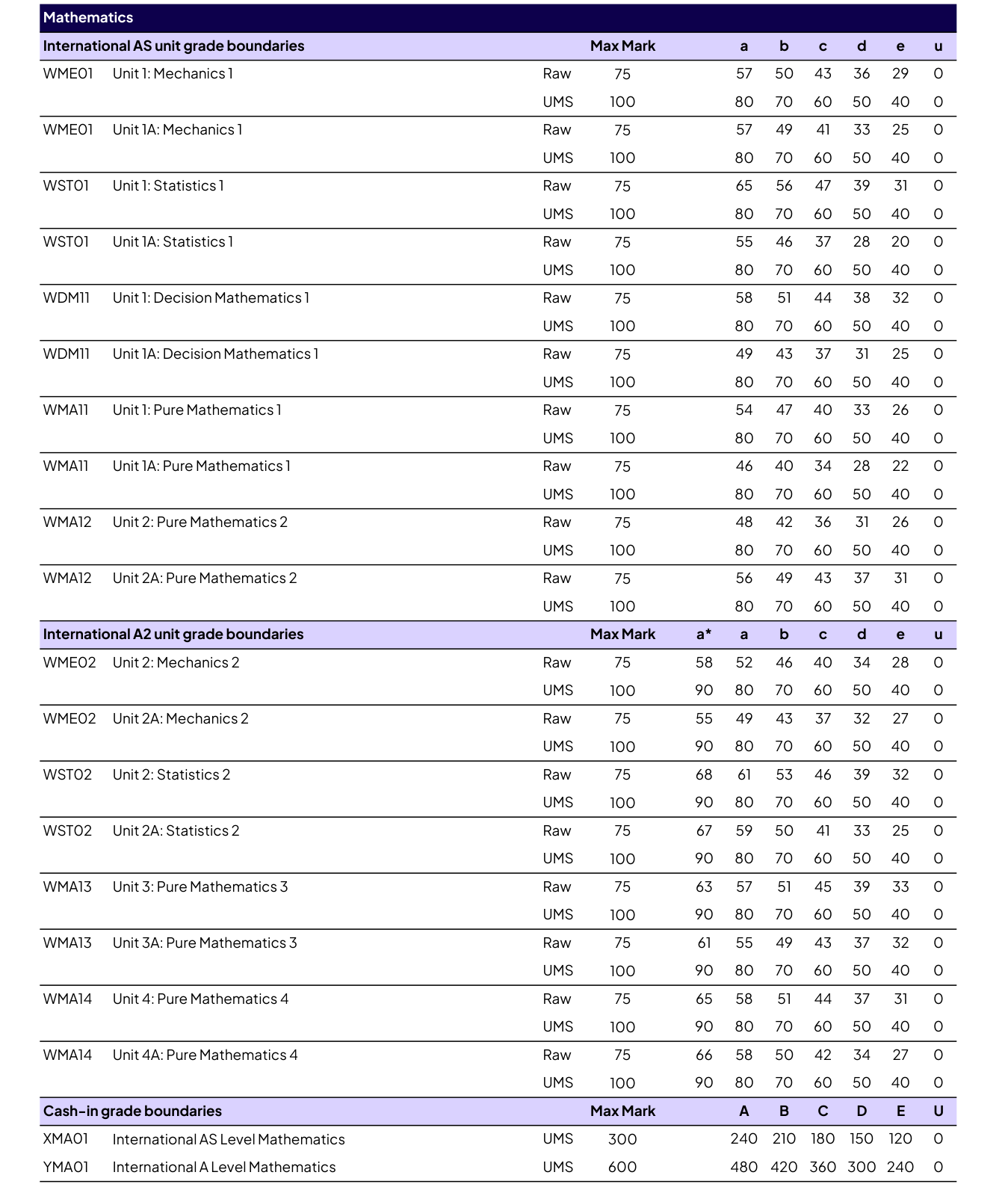
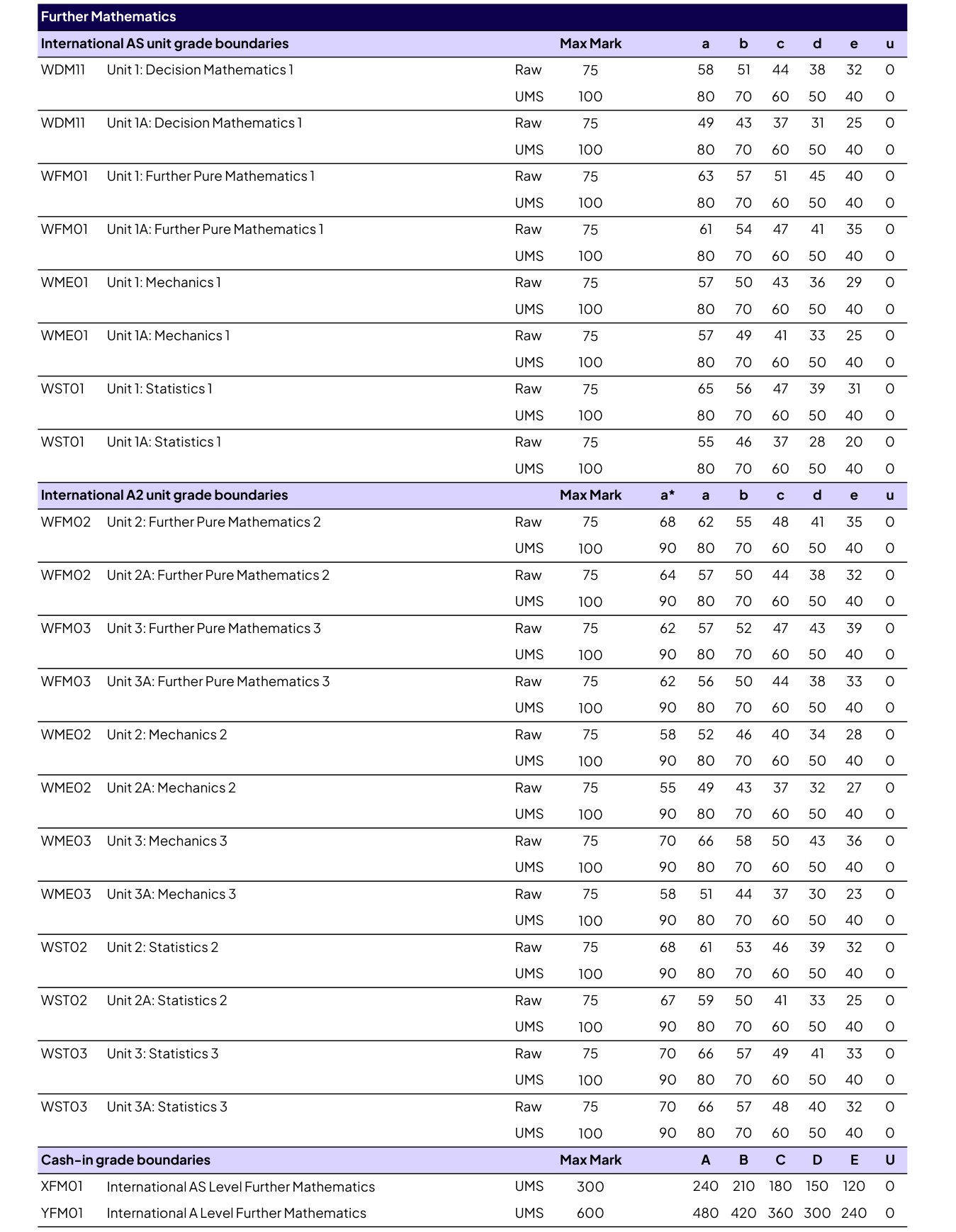
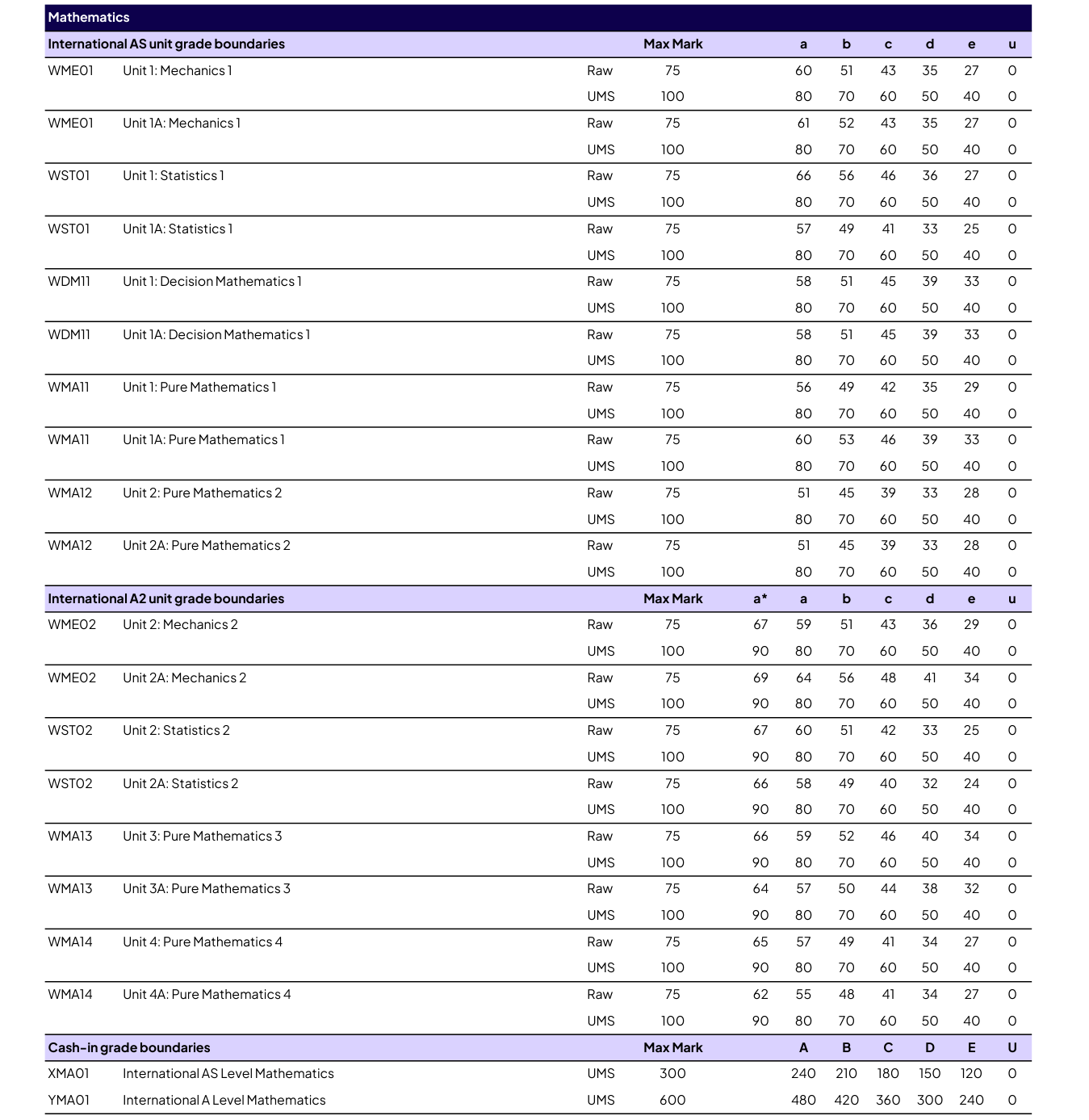
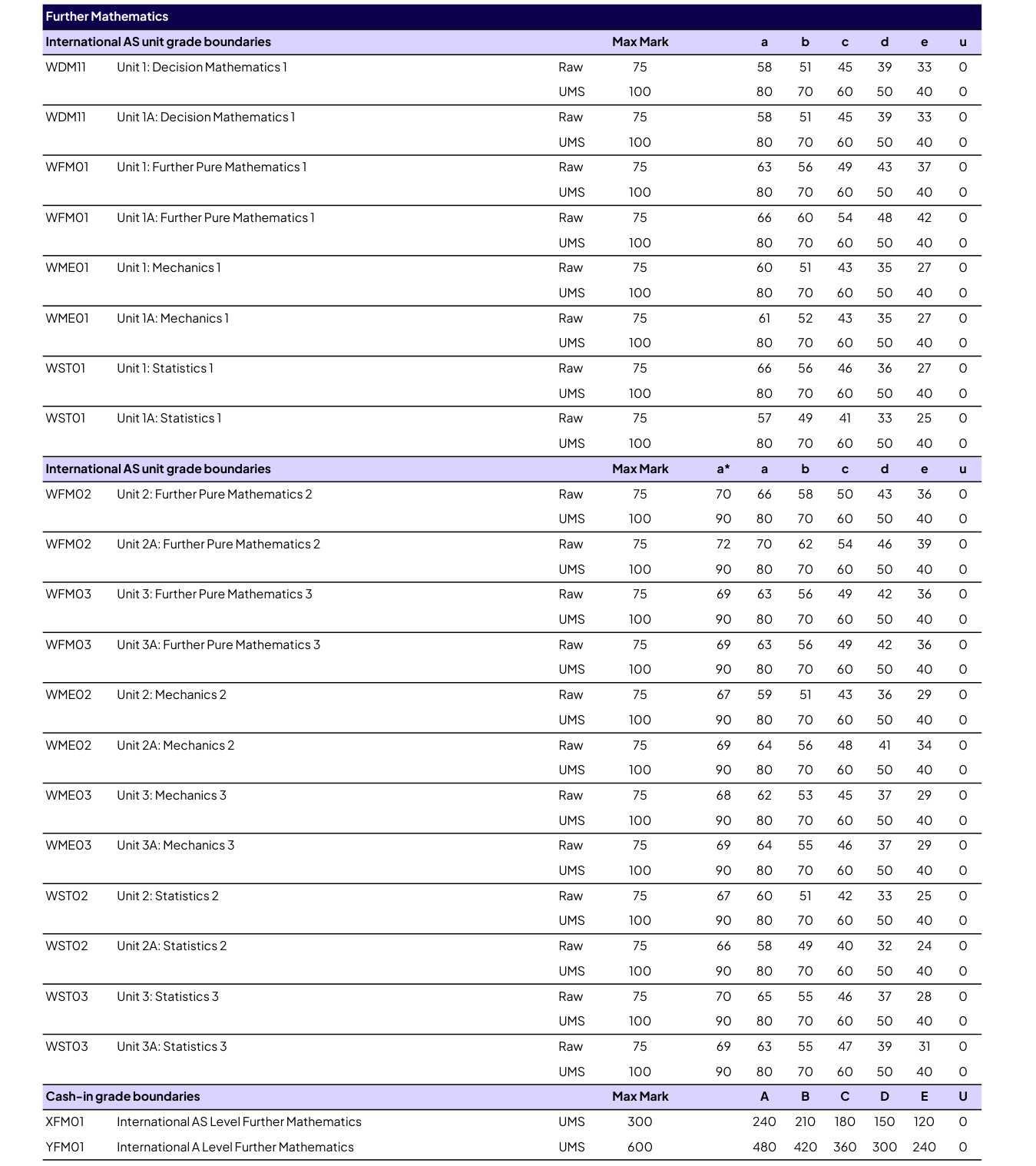
📈 近三次考季分数线(官方文件截图)
每次考季后 Pearson 按当次试卷难度公布各单元的 Raw(原始分)分界;UMS 分界固定不变(AS 单元 a–e 对应 80/70/60/50/40,A2 单元另设 a* = 90)。表中同一单元的两行(如 Unit 1 与 Unit 1A)为同一份试卷的不同版本,Raw 分界不同、UMS 分界相同,具体以考生所考版本为准。
📍 2026年6月考季
📍 2026年1月考季
📍 2025年10月考季
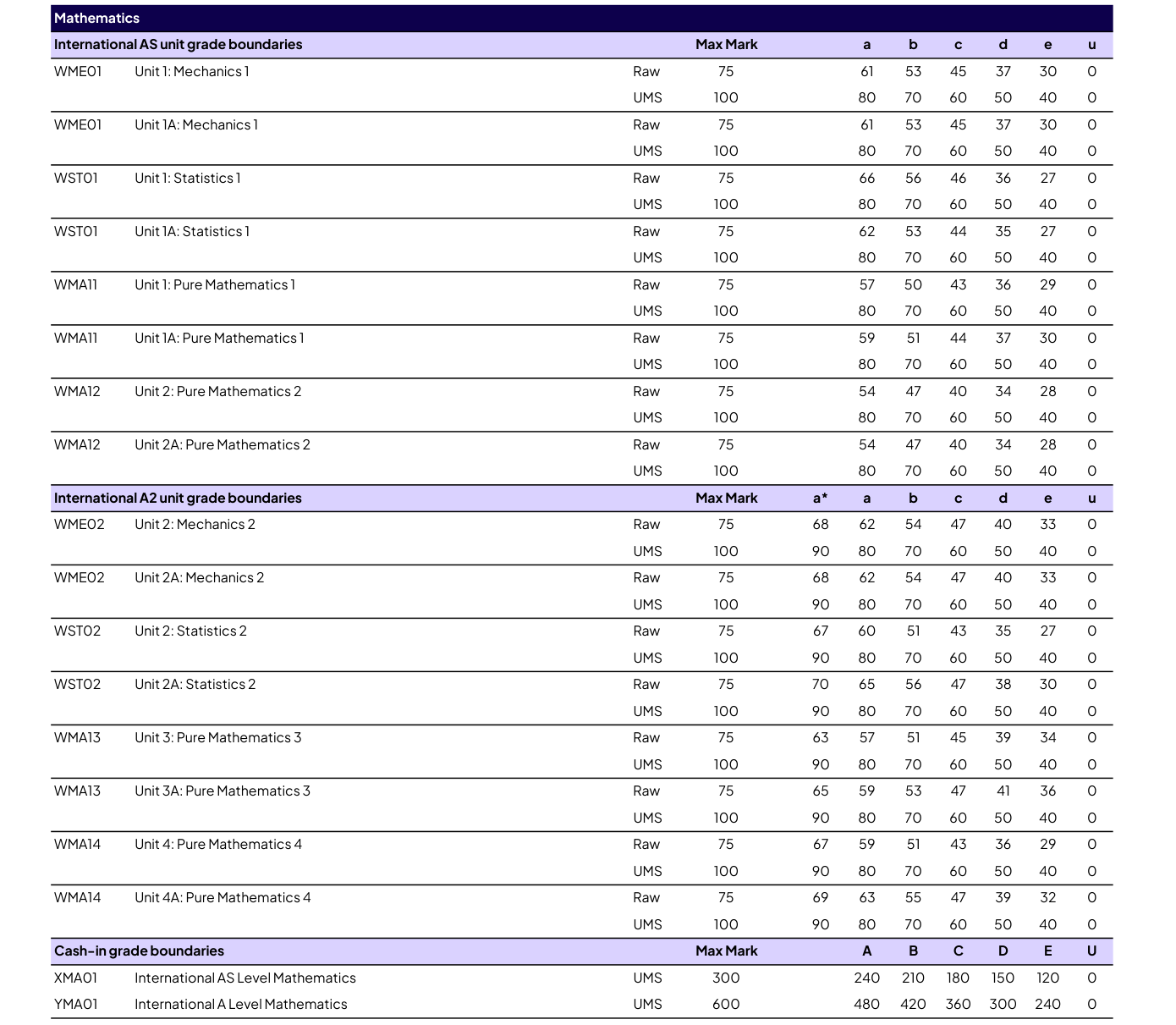
截图来源:qualifications.pearson.com 官方「Grade boundaries — International A Level」文件(2026 年 6 月 / 2026 年 1 月 / 2025 年 10 月考季)。2025 年 10 月考季官方文件未含进阶数学段落(该考季未开放相应单元)。
分类真题稍后补充。
同一考季只保留一条链接:QP(试卷)/ MS(评分表)优先用 Pearson 官方直链,官方未公开该考季时才回退到第三方镜像 PMT(physicsandmathstutor.com,链接带 <em>PMT</em> 小标签);MA(Model Answers 详解)仅 PMT 有,ER(Examiner Report 考官报告)仅官方有。
⚠️ October 2025 / January 2026 / June 2026 三个考季:官方材料已上传但锁在教师账号后(访问跳登录页),第三方也尚未收录——本站不提供这三个考季的链接,需要请登录 Pearson 官方 course materials 页或经所在 centre 获取。
同一次考试可能有多个版本(如 Unit 1 与 Unit 1A),另有少量“(Unused)”备用卷,以表中实际列为准。
📄 Pure Mathematics 4(WMA14)· 历年真题与评分材料
| 考季 | 试卷 QP | 评分表 MS | 详解 MA | 考官报告 ER |
|---|---|---|---|---|
| October 2020 | QP | MS PMT | – | – |
| January 2021 | QP PMT | MS | – | – |
| June 2021 | QP | MS PMT | – | – |
| October 2021 | QP PMT | MS PMT | – | – |
| January 2022 | QP PMT | MS PMT | – | – |
| June 2022 | QP | MS | – | ER |
| October 2022 | QP | MS | – | ER |
| January 2023 | QP | MS | – | ER |
| June 2023 | QP | MS | – | ER |
| October 2023 | QP | MS | – | ER |
| January 2024 | QP | MS | – | ER |
| June 2024 | QP | MS | – | ER |
| October 2024 | QP | MS | – | ER |
| January 2025 | QP | MS | – | ER |
| June 2025 | QP | MS | – | ER |
本单元索引页:PMT https://www.physicsandmathstutor.com/a-level-maths-papers/edexcel-maths-ial-papers/; Pearson 官方 Mathematics (2018) course materials(需教师账号的考季也在这里登录获取)。
QP = Question paper 试卷 · MS = Mark scheme 评分表 · MA = Model answers 详解 · ER = Examiner report 考官报告。 未带小标签的为 **Pearson 官方**直链;带 PMT 小标签的为第三方镜像(physicsandmathstutor.com)。 同一考季同一文档只保留一条链接,官方优先。全部链接 2026-10-15 逐条实测可下载。