该板块暂无内容。
内容稍后补充。
1不等式Inequalities
代数解法Algebraic solutions
记住:不等式两边同时乘以一个负数时,不等号必须反向: 2x > 3 ⇒ −2x < −3.
真正的麻烦出在两边同乘的式子里含未知数的时候,例如 (x − 2):它有时为正(x > 2)、有时为负(x < 2)、有时为零(x = 2)。这种情况下我们把两边同乘 (x − 2)2,它恒为正(只要 x ≠ 2)。
Example 1:Solve the inequality 2x + 3 < x2x − 2, x ≠ 2
Solution:Multiply both sides by (x − 2)2we can do this since (x − 2) ≠ 0
注意 — 不等号取 ≤ 或 ≥ 时要格外小心。
Example 2:Solve the inequality xx + 1 ≥ 2x + 3 , x ≠ −1, x ≠ −3
Solution:Multiply both sides by (x + 1)2(x + 3)2which cannot be zero
from sketch it looks as though the solution is
BUT since x ≠ −1, x ≠ −3,
图象解法Graphical solutions
Example 1:On the same diagram sketch the graphs of y = 2xx + 3 and y = x − 2.
Use your sketch to solve the inequality 2xx + 3 ≥ x − 2
Solution:First find the points of intersection of the two graphs
From the sketch we see that
含 |2x − 5| 这类绝对值的不等式,往往必须先画图。
Example 2:Solve the inequality |x2 − 19| < 5(x − 1).
Solution:It is essential to sketch the curves first in order to see which solutions are needed.
To find the point A, we need to solve
From the sketch x ≠ −8⇒x = 3
To find the point B, we need to solve
From the sketch x ≠ −2⇒x = 7
2数列求和Series – Method of Differences
诀窍在于:把每一行都完整写出来,看相加时哪些项会相互抵消。
不要急着把每一项都算出来——那样会丢掉让你在相加时得以抵消的那个规律。
Example 1:Write 1r(r + 1) in partial fractions, and then use the method of differences to find the sum
n∑r=11r(r + 1) = 11 × 2 + 12 × 3 + 13 × 4 + ⋯ + 1n(n + 1).
Example 2:Write 2r(r + 1)(r + 2) in partial fractions, and then use the method of differences to find the sum
n∑r=11r(r + 1)(r + 2) = 11 × 2 × 3 + 12 × 3 × 4 + 13 × 4 × 5 + ⋯ + 1n(n + 1)(n + 2).
3复数Complex Numbers
模与辐角Modulus and Argument
复数 z = x + iy 的模,就是 z 的长度
而 z 的辐角,是 z 与 x 轴正方向所成的角,−π < arg z ≤ π。
注意:arg z 并不总等于 tan−1(yx)
性质Properties
欧拉公式 eiθEuler’s Relation
Example:Express 5e(i3π4) in the form x + iy.
Solution: 5e(i3π4) = 5(cos(3π4) + i sin(3π4))
模辐角形式的乘除Multiplying and dividing in mod-arg form
同样,
棣莫弗定理De Moivre’s Theorem
棣莫弗定理的应用Applications of De Moivre’s Theorem
Example:Express sin 5θ in terms of sin θ only.
Solution:From De Moivre’s Theorem we know that
Equating imaginary parts
由此可以证明
Example:Express sin5θ in terms of sin 5θ, sin 3θ and sinθ.
Solution:Here we are dealing with sinθ, so we use
复数 n 次方根nth roots of a complex number
求任意复数的 n 次方根,方法完全相同。
Example:Find the 4th roots of 82 + 82i, and show the roots on an Argand Diagram.
Solution:We need to solve the equation z4 = 82 + 82i
注意:这些根关于原点对称分布,相邻两根之间的夹角是 2π4 = π2。
n 次方根之间的夹角总是 2πn。
对六次方根,相邻两根的夹角是 2π6 = π3,依此类推。
实系数多项式方程的根Roots of polynomial equations with real coefficients
1. 任何实系数多项式方程,
其中所有 ai 都是实数,都有复数解
2. ⇒ 任何 nth 次复系数多项式都可以在复数域上分解为 n 个一次因式
3. 若 z = a + ib 是 (I) 的根,那么它的共轭 a − ib 也是根 − 见 FP1。
4. 把因式按共轭成对配起来,就可以说:任何实系数多项式都可以在实数域上分解为一次因式与二次因式的乘积。
Example:Given that 3 − 2i is a root of z3 − 5z2 + 7z + 13 = 0
(a) Factorise over the real numbers
(b) Find all three real roots
Solution:
(a) 3 − 2i is a root ⇒ 3 + 2i is also a root
(b) ⇒ roots are z = 3 − 2i, 3 + 2i and −1
Argand 图上的轨迹Loci on an Argand Diagram
两个基本想法Two basic ideas
1. |z – w| 是 w 到 z 的距离。
2. arg (z – (1 + i)) 是把 (1+i) 与 z 连起来的半直线与 x 轴所成的角。
Example 1:
|z – 2 – i| = 3 is a circle with centre (2 + i) and radius 3
Example 2:
|z + 3 – i| = |z – 2 + i|
is the locus of all points which are equidistant from the points A (– 3, 1) and B (2, –1), and so is the perpendicular bisector of AB.
Example 3:
arg (z – 4) = 5π6 is a half line, from (4, 0), making an angle of 5π6 with the x-axis.
Example 4:
|z – 3| = 2| z + 2i| is a circle (Apollonius’s circle).
To find its equation, put z = x + iy
which is a circle with centre (–1, −83 ) and radius 2133.
Example 5:
which gives the arc of the circle as shown.
N.B.
x 轴下方对应的那段弧,方程是
因为在这幅图里 θ – φ 会取负值(θ 是一个比 φ 更大的负数)。
复平面的变换Transformations of the Complex Plane
永远从 z 平面出发,变到 w 平面;记 z = x + iy 与 w = u + iv。
Example 1:Find the image of the circle |z − 5| = 3
under the transformation w= 1z−2 .
Solution: First rearrange to find z
Second substitute in equation of circle
which is the equation of the perpendicular bisector of the line joining 0 to 13,
务必先考虑上面的「模法」;
若模法行不通,再用下面演示的 u + iv 法。
Example 2:Show that the image of the line x + 4y = 4 under the transformation w= 1z−3 is a circle, and find its centre and radius.
Solution:First rearrange to find z ⇒ z = 1w+ 3.
The ‘modulus technique’ is not suitable here.
z = x + iy and w = u + iv
Equating real and imaginary parts x = uu2+v2 + 3 and y = −vu2+v2
which is a circle with centre (12, −2) and radius 172.
书里还有很多例题,但重要的技巧就是上面这两个。
轨迹与几何Loci and geometry
画图永远很重要。
Example: z lies on the circle |z − 2i| = 1.
Find the greatest and least values of arg z.
Solution: Draw a picture!
The greatest and least values of arg z will occur at B and A.
Trigonometry tells us that
and so greatest and least values of arg z are 2π3 and π3
4一阶微分方程First Order Differential Equations
分离变量与曲线族Separating the variables, families of curves
Example:Find the general solution of
dydx = y2x(x+1) , for x > 0,
and sketch some of the family of solution curves.
Solution: dydx = y2x(x+1) ⇒ ∫ 2y dy = ∫ 1x(x+1) dx = ∫ 1x− 1x+1 dx
Thus for varying values of A and for x > 0, we have
恰当方程Exact Equations
在恰当方程里,左端本身就是一个恰当导数(这其实是为后面的积分因子做准备)。
Example: Solve sin x dydx + y cos x = 3x2
Solution:Notice that the L.H.S. is an exact derivative
sin x dydx + y cos x = ddx(y sin x)
积分因子Integrating Factors
这时,两边同乘一个积分因子 R = e∫P dx。
左端就变成一个恰当导数 ddx(Ry)。
然后照上一例的做法继续。
Example: Solve x dydx + 2y = 1
Solution:First divide through by x
换元法Using substitutions
Example 1: Use the substitution y = vx (where v is a function of x) to solve the equation
dydx = 3yx2+y3x3 + xy2 .
Solution: y = vx ⇒ dydx = v + x dvdx
and we can now separate the variables
and I would not like to find y!!!
如果题目要求用换元 v=yx,就改写成 y = vx,然后照上一例做。
Example 2: Use the substitution y = 1z to solve the differential equation
dydx = y2 + y cot x .
Solution: y = 1z ⇒ dydx = −1z2 dzdx
Example 3: Use the substitution z = x + y to solve the differential equation
dydx = cos(x + y)
Solution: z = x + y ⇒ dzdx=1 + dydx
5二阶微分方程Second Order Differential Equations
常系数线性方程Linear with constant coefficients
(1) 当 f(x) = 0 时
先写出辅助方程(A.E)
再解出它的根 m = α、β
(i) 若 α、β 都是实数,且 α ≠ β
则补函数(C.F.)为
y = A eαx + B eβx, 其中 A 与 B 是任意常数。
(ii) 若 α、β 都是实数,且 α = β
则补函数(C.F.)为
y = (A+Bx) eαx, 其中 A 与 B 是任意常数。
(iii) 若 α、β 都是复数,且 α = a + ib,β = a − ib
则补函数(C.F.)为
y = eax(A sin bx + B cos bx),
其中 A 与 B 是任意常数。
Example 1:Solve d2ydx2 + 2dydx − 3y = 0
Solution:A.E. is m2 + 2m − 3 = 0
Example 2:Solve d2ydx2 + 6dydx + 9y = 0
Solution:A.E. is m2 + 6m + 9 = 0
Example 3:Solve d2ydx2 + 4dydx + 13y = 0
Solution:A.E. is m2 + 4m + 13 = 0
(2) 当 f(x) ≠ 0 时,特解
第一步照 (1) 的做法求出补函数,再用下面的规则求一个特解(P.I.)。
第二步把 C.F. 与 P.I. 相加,就得到通解(G.S.)。
注意:用哪个 P.I. 都无所谓,所以不妨挑最好算的那个, 下面这几条规则就是用来挑的。
f(x) = ekx.
试设 y = Aekx
但若 ekx 已经单独出现在 C.F. 里,就改试 y = Cxekx
若 xekx 也已单独出现在 C.F. 里,则试 y = Cx2ekx。
f(x) = sin kx 或 f(x) = cos kx
试设 y = C sin kx + D cos kx
但若 sin kx 或 cos kx 已经单独出现在 C.F. 里,则
试设 y=x(C sin kx + D cos kx)
f(x) = 关于 x 的 n 次多项式。
试设 f(x) = anxn + an−1xn−1 + an−2xn−2 + … + a1x + a0
但若 C.F. 里已经单独出现了一个常数,则
试设 f(x) = x(anxn + an−1xn−1 + an−2xn−2 + … + a1x + a0)
也就是试设 f(x) = 关于 x 的 n 次多项式。
一般情形
求 P.I. 时先照 f(x) 的样子试设;若它出现在 C.F. 里(或者遇到麻烦),就改照 xf(x) 的样子试设。
Example 1:Solve d2ydx2 + 6dydx + 5y = 2x
Solution:A.E. is m2 + 6m + 5 = 0
For the P.I., try y = Cx + D
Substituting in the differential equation gives
0 + 6C + 5(Cx + D) = 2x
Example 2:Solve d2ydx2 − 6dydx + 9y = e3x
Solution:A.E. is is m2 − 6m + 9 = 0
In this case, both e3x and xe3x appear, on their own, in the C.F., so for a P.I. we try y=Cx2e3x
Substituting in the differential equation gives
2Ce3x + 12Cxe3x + 9Cx2e3x − 6(2Cxe3x + 3Cx2e3x) + 9 Cx2e3x = e3x
Example 3:Solve d2xdt2 − 3dxdt + 2x = 4 cos 2t
given that x = 0 and ẋ = 1 when t= 0.
Solution:A.E. is m2 − 3m + 2 = 0
Substituting in the differential equation gives
(−4C sin 2t − 4D cos 2t) − 3(2C cos 2t − 2D sin 2t) + 2(C sin 2t + D cos 2t) = 4 cos 2t
形如 ax2d2ydx2 + bxdydx + cy = f(x) 的方程D.E.s of the form
作换元x = eu
把这些代回原方程,就化成一个常系数二阶微分方程。
Example:Solve the differential equation x2d2ydx2 − 3x dydx + 3y = −2x2.
Solution:Using the substitution x = eu, and proceeding as above
x2d2ydx2 = d2ydu2 − dydu and xdydx = dydu
For the P.I. try y = Ce2u
6麦克劳林级数与泰勒级数Maclaurin and Taylor Series
1) 麦克劳林级数
2) 泰勒级数
3) 泰勒级数:写成 (x − a) 的幂级数
在 2) 中把 x 换成 (x − a),得
4) 用泰勒级数解微分方程
(a) 若已知 x = 0 时 y 的值,就用麦克劳林级数,其中
从而得到
(b) 若已知 x = a 时 y 的值,就用泰勒级数,其中
从而得到
注意:4 (a) 与 4 (b) 不在公式册里,但用 1) 与 3) 的结果很容易推出来。
标准级数Standard series
Example 1:Find the Maclaurin series for f(x) = tan x, up to and including the term in x3
Example 2:Using the Maclaurin series for ex to find an expansion of ex+x2, up to and including the term in x3.
Solution: ex = 1 + x + x22! + x33! + …
Example 3:Find a Taylor series for cot(x + π4), up to and including the term in x2.
Solution: f(x) = cot x and we are looking for
Example 4:Use a Taylor series to solve the differential equation,
up to and including the term in x3, given that y = 1 and dydx = 2 when x = 0.
In this case the initial value of x is 0, so we shall use
复合函数的级数展开Series expansions of compound functions
Example:Find a polynomial expansion for
cos 2x1 − 3x , up to and including the term in x3.
Solution:Using the standard series
7极坐标Polar Coordinates
点 P 的极坐标是 (r, θ)
其中 r = OP 是到原点(极点 pole)的距离,
而 θ 是从初始线(initial line)按逆时针方向量出的角。
在 Edexcel 大纲里 r 一律取正值或 0,且 0 ≤ θ < 2π
(但在大多数书里 r 可以取负值,因此 (−4, π2) 与 (4, 3π2) 表示同一个点)
极坐标与直角坐标Polar and Cartesian coordinates
由上图可得
而 tan θ= yx(用草图判断 θ 落在第几象限)。
x = r cos θ 与 y = r sin θ。
曲线草图Sketching curves
实际操作里,若被要求画一条曲线的草图,最好的办法通常是先描几个点。所谓 θ 的「关键值」,就是那些使 r = 0 的值。
本讲义里的草图会用虚线画出 r 取负值的那几段;就 Edexcel A-level 而言,这些部分可以忽略。
常见曲线Some common curves
在直角坐标里,y = f(x − a) 的图象是 y = f(x) 的图象沿 x 轴方向平移 a 得到的。
同样地,r = 3 sec(θ − α),或 r = 3 sec(α − θ) 的图象,是把 r = sec θ 的图象绕极点逆时针旋转 α 得到的。
玫瑰线 Rose Curves
当 n 为奇数时,玫瑰线在 0 ≤ θ < 2π 范围内总有 n 个花瓣。
r = 3 cos 4θ
当 n 为偶数时,在 r ≥ 0 且 0 ≤ θ < 2π 的范围内有 n 个花瓣。
因此,不论 n 是奇数还是偶数,只要只取 r 的正值(或 0),玫瑰线 r = a cos θ 总有 n 个花瓣。
Edexcel 只允许 r 取正值或 0。
用极坐标求面积Areas using polar coordinates
圆 r = 10 cos θ
注意:在以 OA 为直径的圆中,角 P 是 90°(半圆上的圆周角),由三角关系可得 r = 10 cos θ。
圆 r = 10 sin θ
同理,r = 10 sin θ 给出的是以 y 轴上的线段为直径的圆。
记住:扇形面积是 12r2θ
当 δθ → 0 时
与初始线平行和垂直的切线Tangents parallel and perpendicular to the initial line
Example: Find the area between the
curve r = 1 + tan θ
and the half lines θ = 0 and θ = π3
Solution:
1)切线平行于初始线(θ = 0),即水平,当 dydx=0:
2)切线垂直于初始线(θ = 0),即竖直,当 dydx 无穷大:
注意:若同时有 dydθ=0 与 dxdθ=0,则 dydx 无定义,此时应借助草图判断(或使用 l’Hôpital 法则)。
Example: Find the coordinates of the points on r=1+cos θ where the tangents are
(a) parallel to the initial line,
(b) perpendicular to the initial line.
Solution: r=1+cos θ is shown in the diagram.
(a) Tangents parallel to θ = 0 (horizontal)
(b) Tangents perpendicular to θ = 0 (vertical)
From the above we can see that
(a) the tangent is parallel to θ = 0
at B (θ=π3), and E (θ=−π3),
also at θ = π, the origin – see below (c)
(b) the tangent is perpendicular to θ = 0
at A (θ = 0), C (θ=2π3) and D (θ=−2π3)
(c) we also have both dxdθ=0 and dydθ=0 when θ = π!!!
From the graph it looks as if the tangent is parallel to θ = 0 at the origin, when θ = π, and from l’Hôpital’s rule it can be shown that this is true.
附录Appendix
n 次单位根的求法nth roots of 1
简捷方法Short method
Example:Find the 5th roots of −4 + 4i = 4√2 e3πi/4
Solution:First find the root with the smallest argument
(4√2 e3πi/4)1/5 = √2 e3πi/20
Then sketch the symmetrical ‘spider’ diagram where the angle between successive roots is 2π5 = 8π20
then find all five roots by successively adding 8π/20 to the argument of each root
to give
√2 e3πi/20, √2 e11πi/20, √2 e19πi/20,
√2 e27πi/20 = √2 e−13πi/20, and √2 e35πi/20 = √2 e−5πi/20.
这可以推广到求任意复数的 n 次方根:把 2πn 逐次加到每个根的辐角上。
警告:考试时务必确保你的方法写得非常清楚。
单位根之和Sum of nth roots of 1
考察 z10 = 1 的解,即 1 的十个 10 次方根。
设 ω 是辐角最小的那个 1 的 10 次方根。「蜘蛛图」显示这些根是 ω, ω2, ω3, ω4, … , ω9 以及 1。
对称性表明这些根的总和是一个实数,但要证明这个和为 0 还需要代数推导。
⇔ 1 的十个 10 次方根之和为 0。
这可以推广:对任意 n,1 的 n 次方根之和都是 0。
一阶微分方程1st order differential equations
积分因子法的证明Justification of the Integrating Factor method.
dydx + Py = Q 其中 P 与 Q 都是 x 的函数。
我们需要找一个积分因子 R(关于 x 的函数),使得用它乘方程左端后得到一个恰当导数。
把左端乘以 R 得到
R dydx + RPy
若要它成为恰当导数,从第一项就能看出应当尝试
ddx(Ry) = R dydx + y dRdx = R dydx + RPy
因此 e∫P dx 就是所需的积分因子(I.F.,Integrating Factor)。
二阶线性微分方程Linear 2nd order differential equations
特征方程与补函数:两个不等的实根Justification of the A.E. – C.F. technique for unequal roots
d2ydx2 + bdydx + cy = 0
不失一般性,可以把 d2ydx2 的系数取作 1。
设特征方程(A.E.)的根为 α 与 β(α ≠ β),则特征方程可写成
于是微分方程可以写成
d2ydx2 − (α + β) dydx + αβy = 0 I
我们可以「形式地因式分解」成
(ddx − α)(dydx − βy) = 0 II
乘开来验算一下令 dydx − βy = z,代入 II,得
但 dydx − βy = z,所以
dydx − βy = A eαx
积分因子是 e−βx。
这就是特征方程有不等实根时的补函数(C.F.)。
特征方程与补函数:两个相等的实根Justification of the A.E. – C.F. technique for equal roots
d2ydx2 + bdydx + cy = 0
不失一般性,可以把 d2ydx2 的系数取作 1。
设特征方程的根为 α 与 α(相等的根),则特征方程可写成
于是微分方程可以写成
d2ydx2 − 2α dydx + α2y = 0 I
我们可以「形式地因式分解」成
(ddx − α)(dydx − αy) = 0 II
乘开来验算一下令 dydx − αy = z,代入 II,得
但 dydx − αy = z,所以
dydx − αy = A eαx
积分因子是 e−αx。
这就是特征方程有相等实根时的补函数(C.F.)。
特征方程与补函数:一对共轭复根Justification of the A.E. – C.F. technique for complex roots
设 α 与 β 是特征方程的复根,那么它们必然以共轭对出现(见 FP1),
至此我们得到了和前面一样求补函数的规则。
先写出特征方程(Auxiliary Equation,A.E.)
A.E. am2+ bm + c = 0
解出根 m = α or β。
α 与 β 都是实数,且 α ≠ β
那么补函数(C.F.)为
y = A eαx + B eβx 其中 A 与 B 是任意积分常数
α 与 β 都是实数,且 α = β
那么补函数(C.F.)为
y = (A + Bx) eαx 其中 A 与 B 是任意积分常数
α 与 β 是一对共轭复数,且 α=a+ib, β=a−ib
那么补函数(C.F.)为
y = eax(A sin bx+ B cos bx), 其中 A 与 B 是任意积分常数
通解、补函数与特解Justification that G.S. = C.F. + P.I.
考虑微分方程 ay′′ + by′ + cy = f (x)
设 u(关于 x 的函数)是补函数中任意一个成员,而 v 是上述微分方程的一个特解。
令 w = u + v
则
aw′′ + bw′ + cw = a(u + v)′′ + b(u + v)′ + c(u + v)
= (au′′ + bu′ + cu) + (av′′ + bv′ + cv) = 0 + f (x) = f (x)
下面还要证明:通解中的任意一个成员都能写成 u + v 的形式,其中 u 是补函数的某个成员,而 v 就是上面用过的那个特解。
设 z 是通解中的任意一个成员,则 az′′ + bz′ + cz = f (x)。
考虑 z − v
a(z − v)′′ + b(z − v)′ + c(z − v) = (az′′ + bz′ + cz) − (av′′ + bv′ + cv)
= f (x) − f (x) = 0
于是通解中的任意成员 z 都能写成 u + v 的形式,其中 u 是补函数的某个成员,而 v 就是上面用过的那个特解。 II
麦克劳林级数Maclaurin’s Series
麦克劳林级数的证明Proof of Maclaurin’s series
要把任意函数表示成 x 的幂级数。
设 f (x) = a + bx + cx2 + dx3 + ex4 + fx5 + … I
照这样继续下去,可以看出 I 中 xn 的系数是 1n!fn(0)。
⇒ f (x) = f (0) + xf ′(0) + x22!f″(0) + x33!f′″(0) + … + xnn!fn(0) + …
这个级数收敛的 x 取值范围取决于 f (x),已超出本课程的范围。
泰勒级数的证明Proof of Taylor’s series
若令 f (x) = g(x + a),则
f (0) = g(a), f ′(0) = g′(a), f ″(0) = g″(a), … , fn(0) = gn(a), …
而麦克劳林级数变成
g (x + a) = g (a) + xg′(a) + x22!g″(a) + x33!g′″(a) + … + xnn!gn(a) + …
这就是把 g(x + a) 按 x 的幂展开的泰勒级数。
把 x 换成 (x − a),就得到
g (x) = g (a) + (x − a)g′(a) + (x−a)22!g″(a) + (x−a)33!g′″(a) + … + (x−a)nn!gn(a) + …
这就是把 g (x) 按 (x − a) 的幂展开的泰勒级数。
🎓 成绩等级与 A* 规则
单元成绩由原始分(Raw)换算为统一分(UMS)后合并计算。各等级所需的最低 UMS 分如下:
| 资格等级 | 最高 UMS 分 | A | B | C | D | E |
|---|---|---|---|---|---|---|
| International AS(合并代码 XMA01、XFM01、XPM01) | 300 | 240 | 210 | 180 | 150 | 120 |
| International A Level(合并代码 YMA01、YFM01、YPM01) | 600 | 480 | 420 | 360 | 300 | 240 |
总 UMS 在 0–119(International AS)或 0–239(International A Level)区间的考生将被评为 Unclassified(U,未分级)。
- IAL 数学(Mathematics):总分达 A(至少 480 / 600),且 P3、P4 两单元合计 UMS 至少 180 / 200,方授予 A*。
- IAL 进阶数学(Further Mathematics):总分达 A(至少 480 / 600),且成绩最好的三个 IA2 单元(纯数或应用单元均可)合计 UMS 至少 270 / 300,方授予 A*。
- IAL 纯数学(Pure Mathematics):总分达 A(至少 480 / 600),且 IA2 单元合计 UMS 至少 270 / 300,方授予 A*。
译自 Pearson Edexcel《International Advanced Level Mathematics / Further Mathematics / Pure Mathematics Specification》(Issue 3, 2019)第 74 页「Qualification results」。
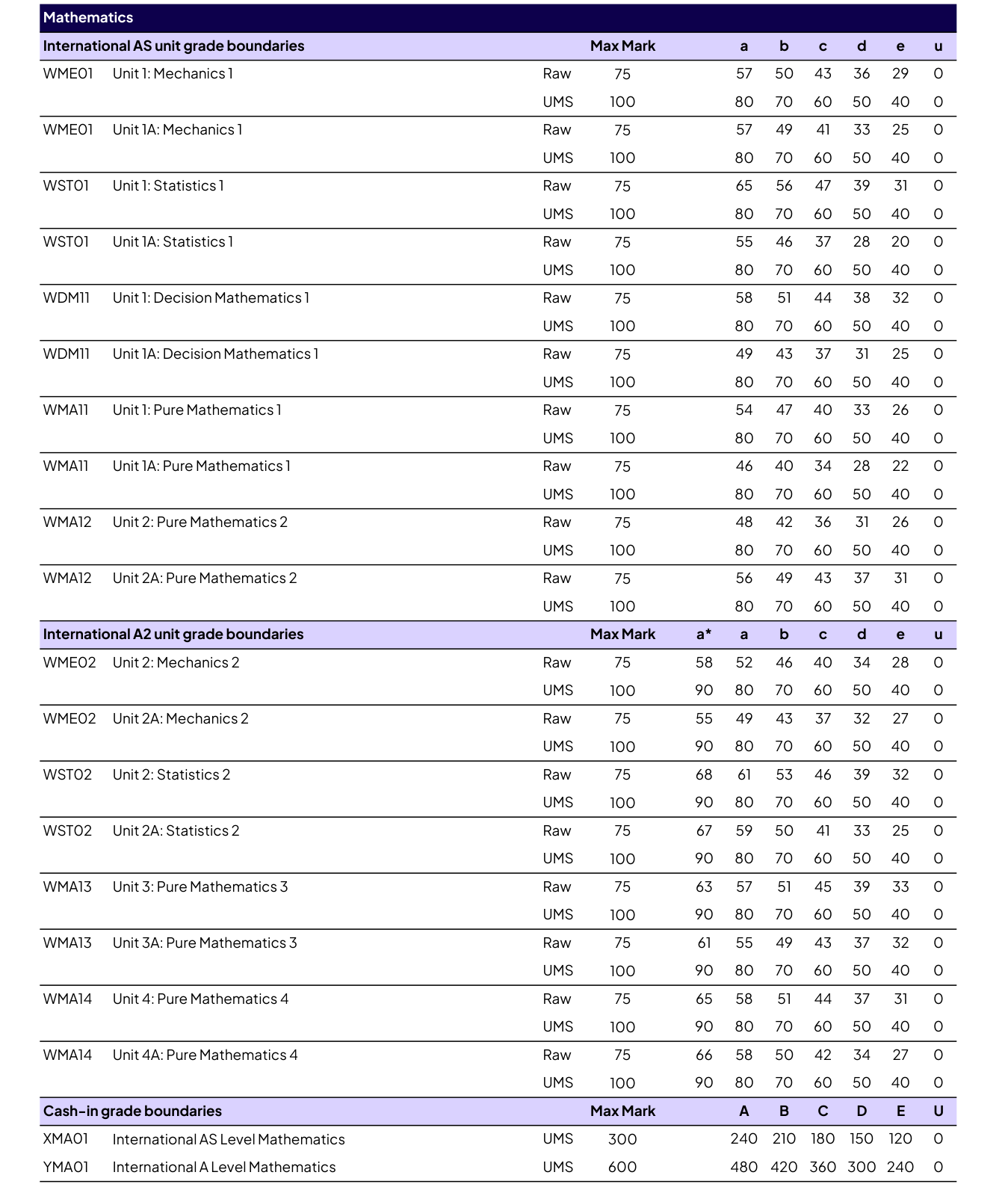
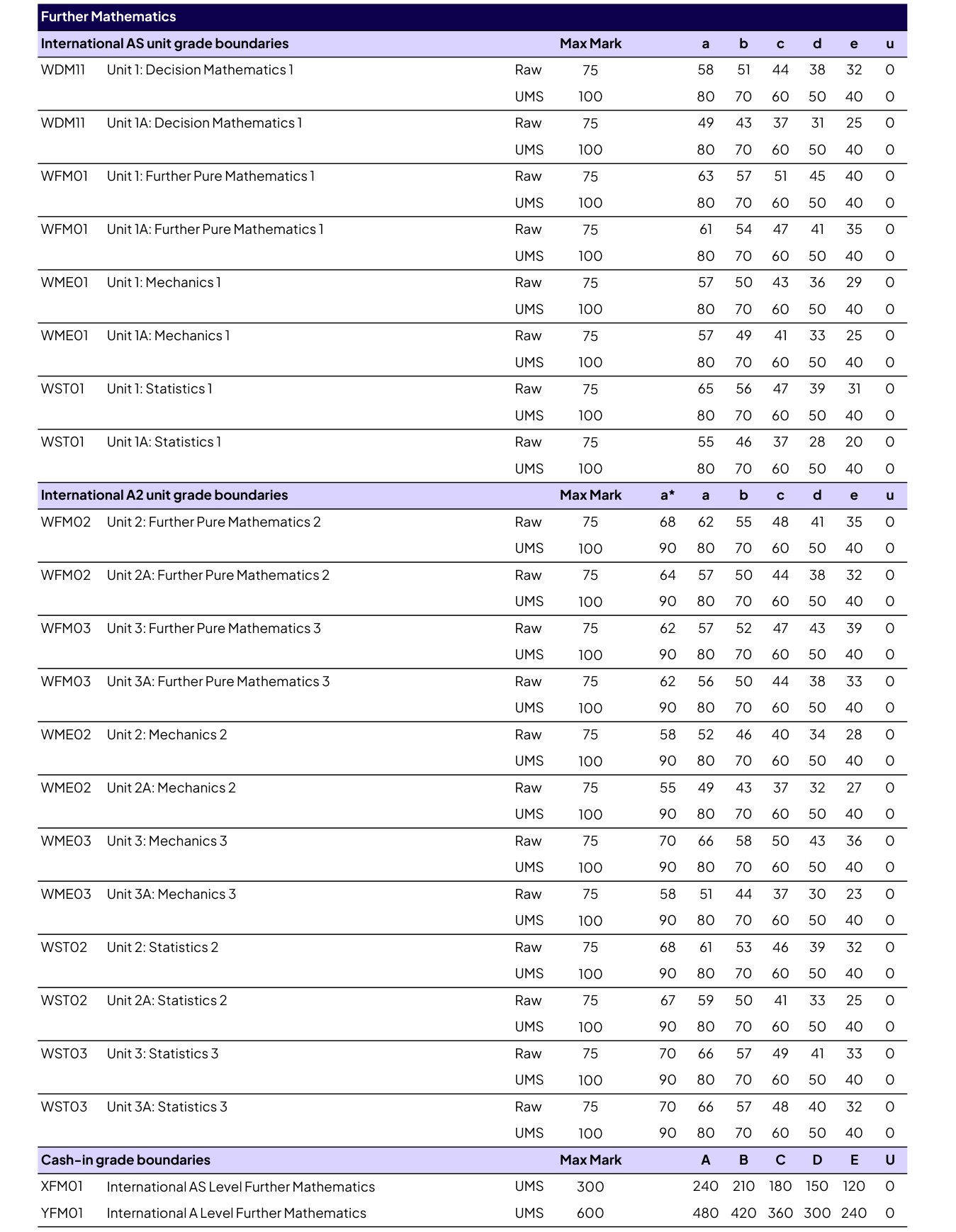
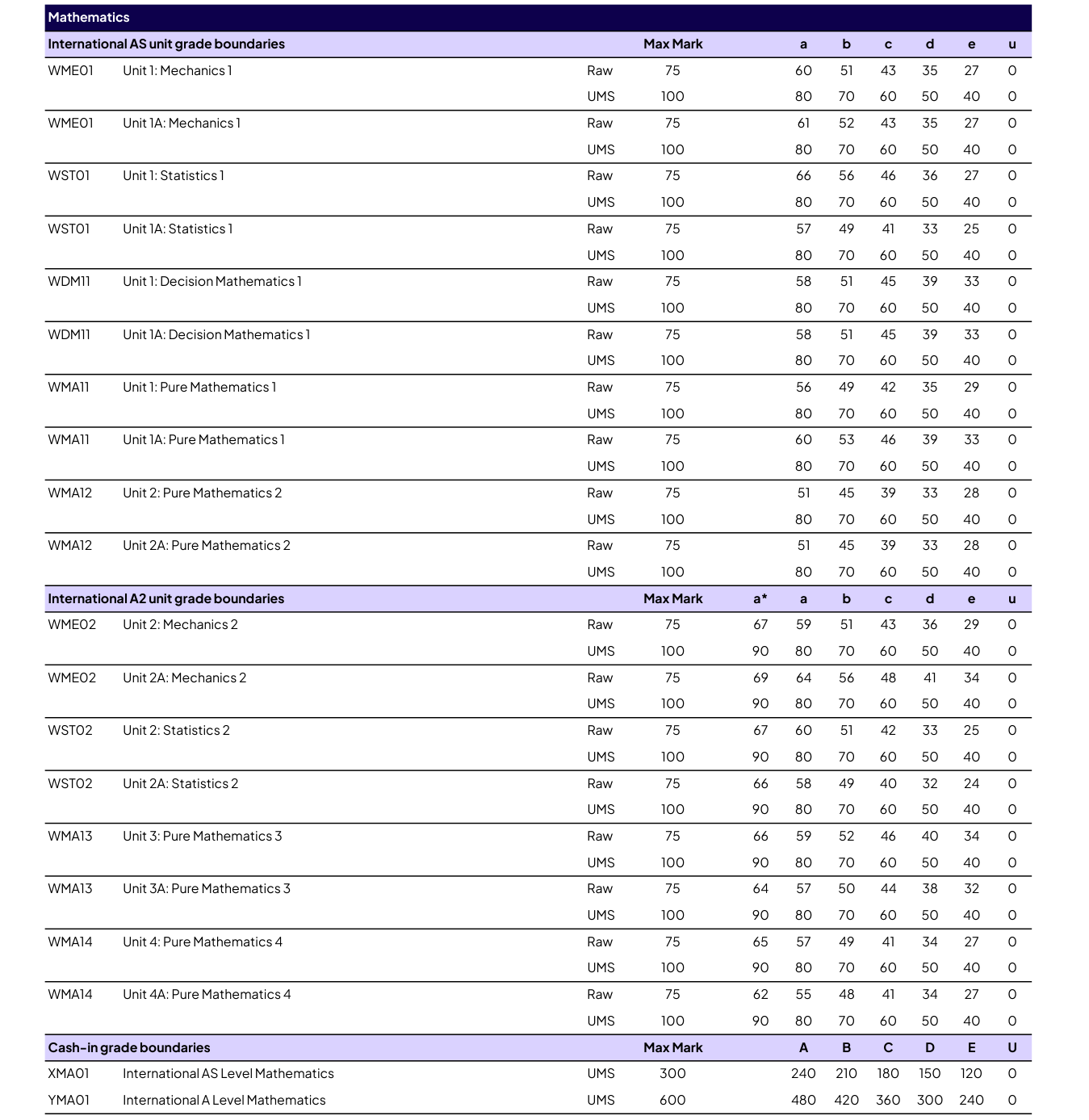
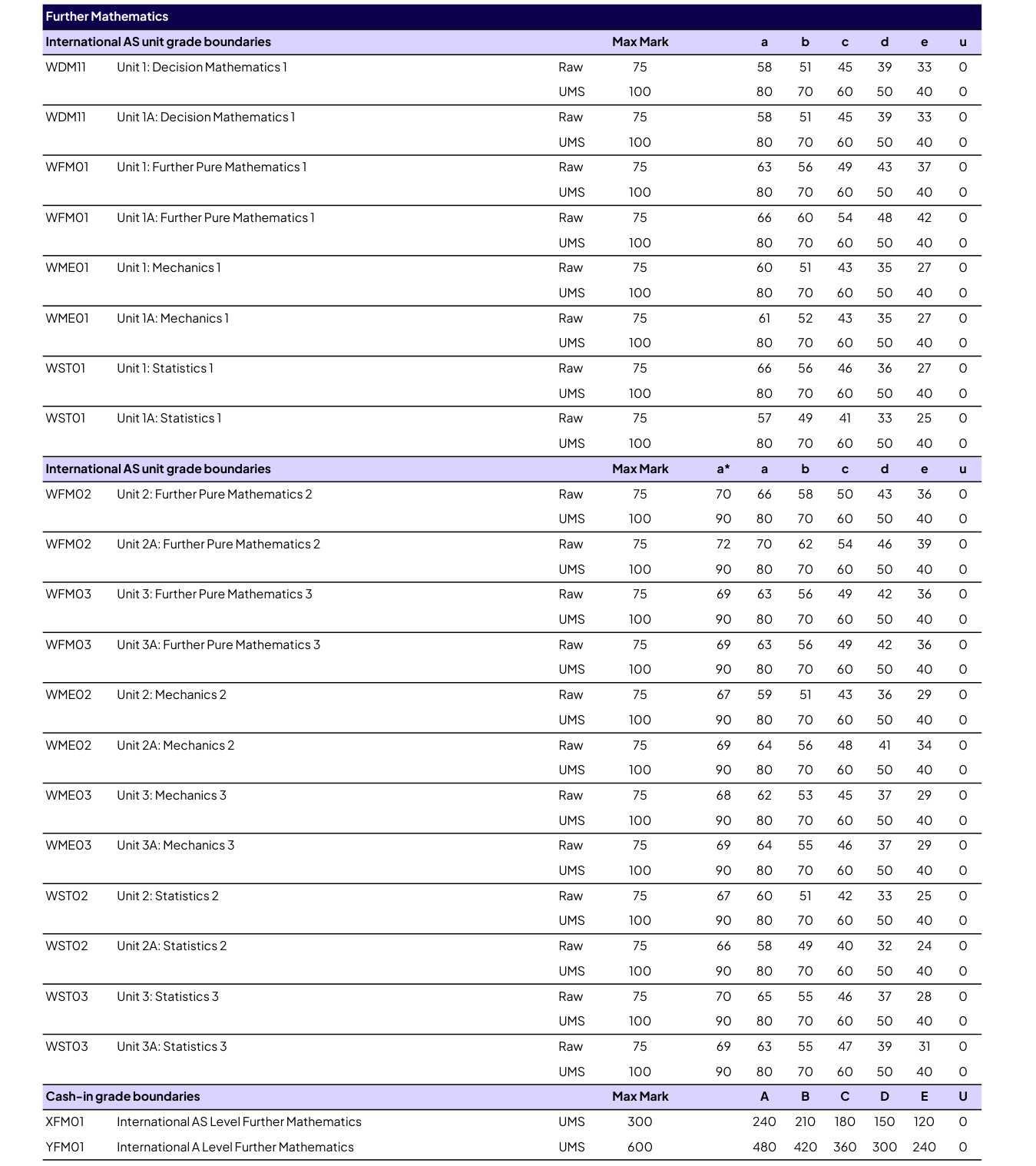
📈 近三次考季分数线(官方文件截图)
每次考季后 Pearson 按当次试卷难度公布各单元的 Raw(原始分)分界;UMS 分界固定不变(AS 单元 a–e 对应 80/70/60/50/40,A2 单元另设 a* = 90)。表中同一单元的两行(如 Unit 1 与 Unit 1A)为同一份试卷的不同版本,Raw 分界不同、UMS 分界相同,具体以考生所考版本为准。
📍 2026年6月考季
📍 2026年1月考季
📍 2025年10月考季
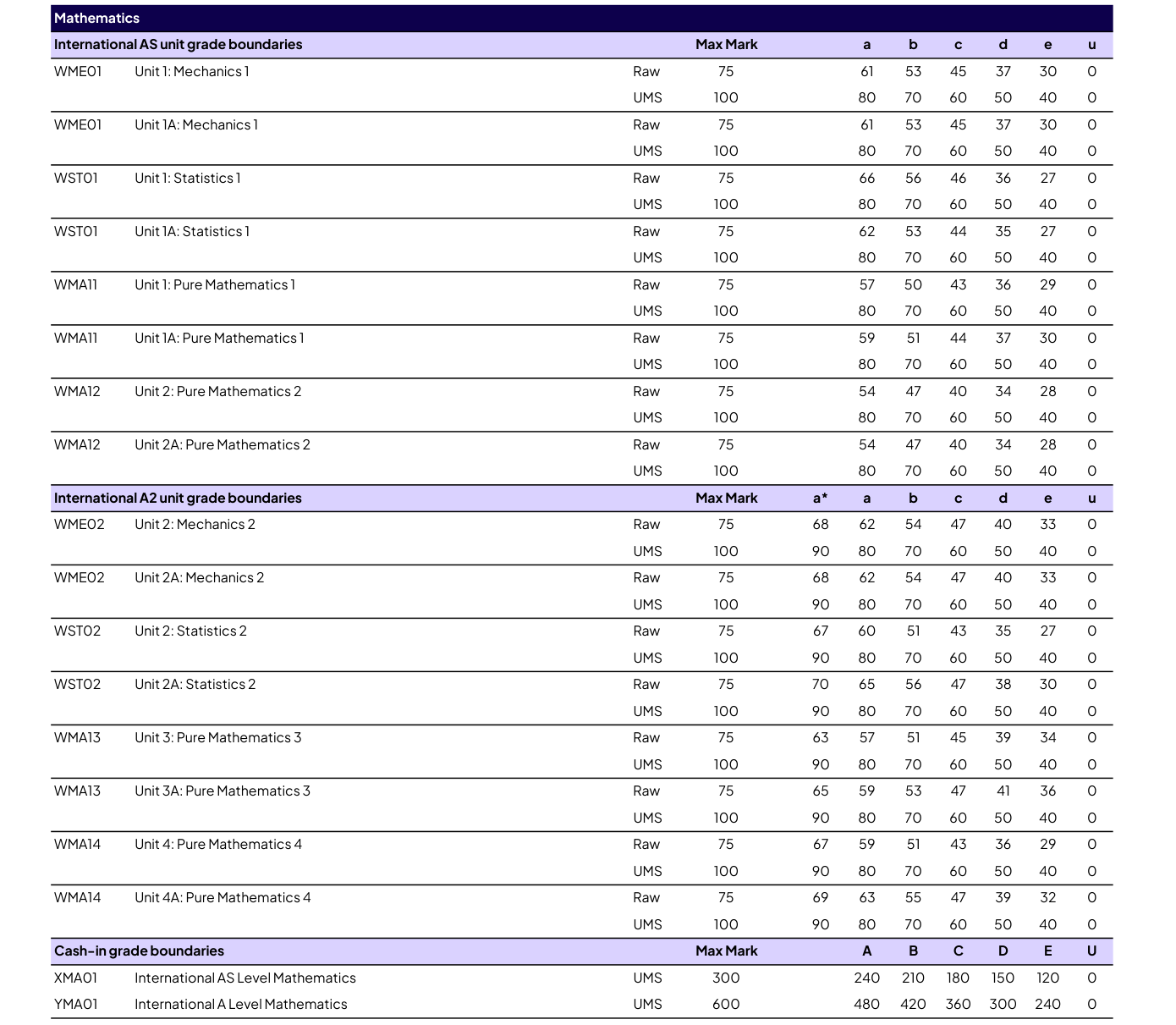
截图来源:qualifications.pearson.com 官方「Grade boundaries — International A Level」文件(2026 年 6 月 / 2026 年 1 月 / 2025 年 10 月考季)。2025 年 10 月考季官方文件未含进阶数学段落(该考季未开放相应单元)。
📝 FP2 分类真题 Categorised Past Papers
Edexcel IAL WFM02 (FP2) 2019–2026 共 16 卷 / 133 题(含 01a 区域变体), 按站点 7 个章节、22 个知识点双语分类。点开任一知识点即可看到对应年份的真题; 每题附「题目 Question」与「详解 Mark Scheme」两个链接,均为所在完整试卷页原版(PDF 整页,不裁剪)。
同一知识点可能出现在多个章节之下(各章只列属于该章的题)。
1 · 不等式 Inequalities (16 题)
代数解法 Algebraic methods (16 题)
| 试卷 Session | 题号 | 分值 | 链接 Links |
|---|---|---|---|
| 2019 Jun | Q1 | 6 | 题目 Question · 详解 Mark Scheme |
| 2020 Oct | Q3 | 9 | 题目 Question · 详解 Mark Scheme |
| 2021 Jun | Q5 | 7 | 题目 Question · 详解 Mark Scheme |
| 2022 Jan | Q3 | 11 | 题目 Question · 详解 Mark Scheme |
| 2022 Jun | Q2 | 8 | 题目 Question · 详解 Mark Scheme |
| 2023 Jan | Q5 | 6 | 题目 Question · 详解 Mark Scheme |
| 2023 Jun | Q3 | 7 | 题目 Question · 详解 Mark Scheme |
| 2024 Jan | Q1 | 5 | 题目 Question · 详解 Mark Scheme |
| 2024 Jun | Q5 | 6 | 题目 Question · 详解 Mark Scheme |
| 2025 Jan | Q2 | 7 | 题目 Question · 详解 Mark Scheme |
| 2025 Jun | Q8 | 10 | 题目 Question · 详解 Mark Scheme |
| 2025 Jun 01A | Q1 | 6 | 题目 Question · 详解 Mark Scheme |
| 2026 Jan | Q5 | 6 | 题目 Question · 详解 Mark Scheme |
| 2026 Jan 01A | Q2 | 6 | 题目 Question · 详解 Mark Scheme |
| 2026 Jun | Q3 | 7 | 题目 Question · 详解 Mark Scheme |
| 2026 Jun 01A | Q1 | 7 | 题目 Question · 详解 Mark Scheme |
2 · 数列求和 Series – Method of Differences (16 题)
方法差 Method of differences (16 题)
| 试卷 Session | 题号 | 分值 | 链接 Links |
|---|---|---|---|
| 2019 Jun | Q3 | 10 | 题目 Question · 详解 Mark Scheme |
| 2020 Oct | Q2 | 9 | 题目 Question · 详解 Mark Scheme |
| 2021 Jun | Q1 | 8 | 题目 Question · 详解 Mark Scheme |
| 2022 Jan | Q6 | 11 | 题目 Question · 详解 Mark Scheme |
| 2022 Jun | Q1 | 5 | 题目 Question · 详解 Mark Scheme |
| 2023 Jan | Q2 | 6 | 题目 Question · 详解 Mark Scheme |
| 2023 Jun | Q1 | 7 | 题目 Question · 详解 Mark Scheme |
| 2024 Jan | Q3 | 7 | 题目 Question · 详解 Mark Scheme |
| 2024 Jun | Q3 | 8 | 题目 Question · 详解 Mark Scheme |
| 2025 Jan | Q4 | 9 | 题目 Question · 详解 Mark Scheme |
| 2025 Jun | Q5 | 10 | 题目 Question · 详解 Mark Scheme |
| 2025 Jun 01A | Q5 | 8 | 题目 Question · 详解 Mark Scheme |
| 2026 Jan | Q1 | 6 | 题目 Question · 详解 Mark Scheme |
| 2026 Jan 01A | Q4 | 8 | 题目 Question · 详解 Mark Scheme |
| 2026 Jun | Q5 | 9 | 题目 Question · 详解 Mark Scheme |
| 2026 Jun 01A | Q2 | 7 | 题目 Question · 详解 Mark Scheme |
级数求和 Summation of series (16 题)
| 试卷 Session | 题号 | 分值 | 链接 Links |
|---|---|---|---|
| 2019 Jun | Q3 | 10 | 题目 Question · 详解 Mark Scheme |
| 2020 Oct | Q2 | 9 | 题目 Question · 详解 Mark Scheme |
| 2021 Jun | Q1 | 8 | 题目 Question · 详解 Mark Scheme |
| 2022 Jan | Q6 | 11 | 题目 Question · 详解 Mark Scheme |
| 2022 Jun | Q1 | 5 | 题目 Question · 详解 Mark Scheme |
| 2023 Jan | Q2 | 6 | 题目 Question · 详解 Mark Scheme |
| 2023 Jun | Q1 | 7 | 题目 Question · 详解 Mark Scheme |
| 2024 Jan | Q3 | 7 | 题目 Question · 详解 Mark Scheme |
| 2024 Jun | Q3 | 8 | 题目 Question · 详解 Mark Scheme |
| 2025 Jan | Q4 | 9 | 题目 Question · 详解 Mark Scheme |
| 2025 Jun | Q5 | 10 | 题目 Question · 详解 Mark Scheme |
| 2025 Jun 01A | Q5 | 8 | 题目 Question · 详解 Mark Scheme |
| 2026 Jan | Q1 | 6 | 题目 Question · 详解 Mark Scheme |
| 2026 Jan 01A | Q4 | 8 | 题目 Question · 详解 Mark Scheme |
| 2026 Jun | Q5 | 9 | 题目 Question · 详解 Mark Scheme |
| 2026 Jun 01A | Q2 | 7 | 题目 Question · 详解 Mark Scheme |
代数解法 Algebraic methods (1 题)
| 试卷 Session | 题号 | 分值 | 链接 Links |
|---|---|---|---|
| 2025 Jun | Q5 | 10 | 题目 Question · 详解 Mark Scheme |
3 · 复数 Complex Numbers (34 题)
模与辐角 Modulus and argument (10 题)
| 试卷 Session | 题号 | 分值 | 链接 Links |
|---|---|---|---|
| 2019 Jun | Q5 | 8 | 题目 Question · 详解 Mark Scheme |
| 2020 Oct | Q4 | 8 | 题目 Question · 详解 Mark Scheme |
| 2022 Jan | Q1 | 7 | 题目 Question · 详解 Mark Scheme |
| 2023 Jun | Q2 | 10 | 题目 Question · 详解 Mark Scheme |
| 2024 Jan | Q2 | 8 | 题目 Question · 详解 Mark Scheme |
| 2025 Jun | Q1 | 6 | 题目 Question · 详解 Mark Scheme |
| 2025 Jun 01A | Q4 | 8 | 题目 Question · 详解 Mark Scheme |
| 2026 Jan 01A | Q1 | 5 | 题目 Question · 详解 Mark Scheme |
| 2026 Jun | Q1 | 9 | 题目 Question · 详解 Mark Scheme |
| 2026 Jun | Q8 | 11 | 题目 Question · 详解 Mark Scheme |
棣莫弗定理 De Moivre's theorem (16 题)
| 试卷 Session | 题号 | 分值 | 链接 Links |
|---|---|---|---|
| 2019 Jun | Q5 | 8 | 题目 Question · 详解 Mark Scheme |
| 2020 Oct | Q4 | 8 | 题目 Question · 详解 Mark Scheme |
| 2021 Jun | Q7 | 9 | 题目 Question · 详解 Mark Scheme |
| 2022 Jan | Q1 | 7 | 题目 Question · 详解 Mark Scheme |
| 2022 Jun | Q8 | 14 | 题目 Question · 详解 Mark Scheme |
| 2023 Jan | Q7 | 8 | 题目 Question · 详解 Mark Scheme |
| 2023 Jun | Q2 | 10 | 题目 Question · 详解 Mark Scheme |
| 2024 Jan | Q2 | 8 | 题目 Question · 详解 Mark Scheme |
| 2024 Jun | Q9 | 8 | 题目 Question · 详解 Mark Scheme |
| 2025 Jan | Q7 | 11 | 题目 Question · 详解 Mark Scheme |
| 2025 Jun | Q9 | 9 | 题目 Question · 详解 Mark Scheme |
| 2025 Jun 01A | Q8 | 12 | 题目 Question · 详解 Mark Scheme |
| 2026 Jan | Q7 | 8 | 题目 Question · 详解 Mark Scheme |
| 2026 Jan 01A | Q7 | 14 | 题目 Question · 详解 Mark Scheme |
| 2026 Jun | Q1 | 9 | 题目 Question · 详解 Mark Scheme |
| 2026 Jun 01A | Q6 | 11 | 题目 Question · 详解 Mark Scheme |
复数 n 次方根 nth roots of a complex number (7 题)
| 试卷 Session | 题号 | 分值 | 链接 Links |
|---|---|---|---|
| 2019 Jun | Q5 | 8 | 题目 Question · 详解 Mark Scheme |
| 2020 Oct | Q4 | 8 | 题目 Question · 详解 Mark Scheme |
| 2022 Jan | Q1 | 7 | 题目 Question · 详解 Mark Scheme |
| 2024 Jan | Q2 | 8 | 题目 Question · 详解 Mark Scheme |
| 2025 Jun | Q1 | 6 | 题目 Question · 详解 Mark Scheme |
| 2026 Jan 01A | Q1 | 5 | 题目 Question · 详解 Mark Scheme |
| 2026 Jun | Q1 | 9 | 题目 Question · 详解 Mark Scheme |
实系数多项式方程的根 Roots of polynomial equations with real coefficients (1 题)
| 试卷 Session | 题号 | 分值 | 链接 Links |
|---|---|---|---|
| 2025 Jun | Q9 | 9 | 题目 Question · 详解 Mark Scheme |
Argand 图上的轨迹 Loci in the Argand diagram (10 题)
| 试卷 Session | 题号 | 分值 | 链接 Links |
|---|---|---|---|
| 2019 Jun | Q2 | 6 | 题目 Question · 详解 Mark Scheme |
| 2020 Oct | Q5 | 7 | 题目 Question · 详解 Mark Scheme |
| 2021 Jun | Q2 | 8 | 题目 Question · 详解 Mark Scheme |
| 2022 Jan | Q7 | 8 | 题目 Question · 详解 Mark Scheme |
| 2022 Jun | Q3 | 8 | 题目 Question · 详解 Mark Scheme |
| 2023 Jan | Q6 | 8 | 题目 Question · 详解 Mark Scheme |
| 2023 Jun | Q2 | 10 | 题目 Question · 详解 Mark Scheme |
| 2024 Jun | Q1 | 4 | 题目 Question · 详解 Mark Scheme |
| 2025 Jun | Q3 | 6 | 题目 Question · 详解 Mark Scheme |
| 2025 Jun 01A | Q4 | 8 | 题目 Question · 详解 Mark Scheme |
复平面的变换 Transformations of the complex plane (14 题)
| 试卷 Session | 题号 | 分值 | 链接 Links |
|---|---|---|---|
| 2019 Jun | Q2 | 6 | 题目 Question · 详解 Mark Scheme |
| 2020 Oct | Q5 | 7 | 题目 Question · 详解 Mark Scheme |
| 2021 Jun | Q2 | 8 | 题目 Question · 详解 Mark Scheme |
| 2022 Jan | Q7 | 8 | 题目 Question · 详解 Mark Scheme |
| 2022 Jun | Q3 | 8 | 题目 Question · 详解 Mark Scheme |
| 2023 Jan | Q6 | 8 | 题目 Question · 详解 Mark Scheme |
| 2023 Jun | Q5 | 7 | 题目 Question · 详解 Mark Scheme |
| 2024 Jan | Q7 | 10 | 题目 Question · 详解 Mark Scheme |
| 2024 Jun | Q6 | 7 | 题目 Question · 详解 Mark Scheme |
| 2025 Jan | Q8 | 13 | 题目 Question · 详解 Mark Scheme |
| 2025 Jun | Q3 | 6 | 题目 Question · 详解 Mark Scheme |
| 2026 Jan | Q6 | 7 | 题目 Question · 详解 Mark Scheme |
| 2026 Jun | Q8 | 11 | 题目 Question · 详解 Mark Scheme |
| 2026 Jun 01A | Q5 | 9 | 题目 Question · 详解 Mark Scheme |
轨迹与几何 Loci and geometry (3 题)
| 试卷 Session | 题号 | 分值 | 链接 Links |
|---|---|---|---|
| 2024 Jun | Q1 | 4 | 题目 Question · 详解 Mark Scheme |
| 2025 Jun 01A | Q4 | 8 | 题目 Question · 详解 Mark Scheme |
| 2026 Jun | Q8 | 11 | 题目 Question · 详解 Mark Scheme |
4 · 一阶微分方程 First Order Differential Equations (16 题)
分离变量与曲线族 Separation of variables and families of curves (1 题)
| 试卷 Session | 题号 | 分值 | 链接 Links |
|---|---|---|---|
| 2022 Jan | Q8 | 14 | 题目 Question · 详解 Mark Scheme |
积分因子 Integrating factors (15 题)
| 试卷 Session | 题号 | 分值 | 链接 Links |
|---|---|---|---|
| 2019 Jun | Q4 | 10 | 题目 Question · 详解 Mark Scheme |
| 2020 Oct | Q6 | 8 | 题目 Question · 详解 Mark Scheme |
| 2021 Jun | Q8 | 11 | 题目 Question · 详解 Mark Scheme |
| 2022 Jun | Q4 | 7 | 题目 Question · 详解 Mark Scheme |
| 2023 Jan | Q3 | 9 | 题目 Question · 详解 Mark Scheme |
| 2023 Jun | Q7 | 11 | 题目 Question · 详解 Mark Scheme |
| 2024 Jan | Q8 | 13 | 题目 Question · 详解 Mark Scheme |
| 2024 Jun | Q4 | 9 | 题目 Question · 详解 Mark Scheme |
| 2025 Jan | Q1 | 6 | 题目 Question · 详解 Mark Scheme |
| 2025 Jun | Q6 | 11 | 题目 Question · 详解 Mark Scheme |
| 2025 Jun 01A | Q2 | 8 | 题目 Question · 详解 Mark Scheme |
| 2026 Jan | Q3 | 10 | 题目 Question · 详解 Mark Scheme |
| 2026 Jan 01A | Q3 | 10 | 题目 Question · 详解 Mark Scheme |
| 2026 Jun | Q4 | 7 | 题目 Question · 详解 Mark Scheme |
| 2026 Jun 01A | Q7 | 10 | 题目 Question · 详解 Mark Scheme |
换元法 Substitution methods (8 题)
| 试卷 Session | 题号 | 分值 | 链接 Links |
|---|---|---|---|
| 2021 Jun | Q8 | 11 | 题目 Question · 详解 Mark Scheme |
| 2022 Jan | Q8 | 14 | 题目 Question · 详解 Mark Scheme |
| 2023 Jan | Q3 | 9 | 题目 Question · 详解 Mark Scheme |
| 2023 Jun | Q7 | 11 | 题目 Question · 详解 Mark Scheme |
| 2024 Jan | Q8 | 13 | 题目 Question · 详解 Mark Scheme |
| 2024 Jun | Q4 | 9 | 题目 Question · 详解 Mark Scheme |
| 2025 Jun | Q6 | 11 | 题目 Question · 详解 Mark Scheme |
| 2026 Jan | Q3 | 10 | 题目 Question · 详解 Mark Scheme |
5 · 二阶微分方程 Second Order Differential Equations (16 题)
常系数线性方程 Linear equations with constant coefficients (11 题)
| 试卷 Session | 题号 | 分值 | 链接 Links |
|---|---|---|---|
| 2023 Jan | Q9 | 13 | 题目 Question · 详解 Mark Scheme |
| 2023 Jun | Q4 | 11 | 题目 Question · 详解 Mark Scheme |
| 2024 Jan | Q6 | 14 | 题目 Question · 详解 Mark Scheme |
| 2024 Jun | Q8 | 10 | 题目 Question · 详解 Mark Scheme |
| 2025 Jan | Q6 | 11 | 题目 Question · 详解 Mark Scheme |
| 2025 Jun | Q4 | 10 | 题目 Question · 详解 Mark Scheme |
| 2025 Jun 01A | Q7 | 13 | 题目 Question · 详解 Mark Scheme |
| 2026 Jan | Q8 | 11 | 题目 Question · 详解 Mark Scheme |
| 2026 Jan 01A | Q6 | 13 | 题目 Question · 详解 Mark Scheme |
| 2026 Jun | Q7 | 13 | 题目 Question · 详解 Mark Scheme |
| 2026 Jun 01A | Q4 | 11 | 题目 Question · 详解 Mark Scheme |
二阶常系数非齐次方程 Inhomogeneous second order linear equations with constant coefficients (16 题)
| 试卷 Session | 题号 | 分值 | 链接 Links |
|---|---|---|---|
| 2019 Jun | Q7 | 15 | 题目 Question · 详解 Mark Scheme |
| 2020 Oct | Q8 | 14 | 题目 Question · 详解 Mark Scheme |
| 2021 Jun | Q6 | 13 | 题目 Question · 详解 Mark Scheme |
| 2022 Jan | Q2 | 6 | 题目 Question · 详解 Mark Scheme |
| 2022 Jun | Q7 | 12 | 题目 Question · 详解 Mark Scheme |
| 2023 Jan | Q9 | 13 | 题目 Question · 详解 Mark Scheme |
| 2023 Jun | Q4 | 11 | 题目 Question · 详解 Mark Scheme |
| 2024 Jan | Q6 | 14 | 题目 Question · 详解 Mark Scheme |
| 2024 Jun | Q8 | 10 | 题目 Question · 详解 Mark Scheme |
| 2025 Jan | Q6 | 11 | 题目 Question · 详解 Mark Scheme |
| 2025 Jun | Q4 | 10 | 题目 Question · 详解 Mark Scheme |
| 2025 Jun 01A | Q7 | 13 | 题目 Question · 详解 Mark Scheme |
| 2026 Jan | Q8 | 11 | 题目 Question · 详解 Mark Scheme |
| 2026 Jan 01A | Q6 | 13 | 题目 Question · 详解 Mark Scheme |
| 2026 Jun | Q7 | 13 | 题目 Question · 详解 Mark Scheme |
| 2026 Jun 01A | Q4 | 11 | 题目 Question · 详解 Mark Scheme |
换元法 Substitution methods (3 题)
| 试卷 Session | 题号 | 分值 | 链接 Links |
|---|---|---|---|
| 2019 Jun | Q7 | 15 | 题目 Question · 详解 Mark Scheme |
| 2020 Oct | Q8 | 14 | 题目 Question · 详解 Mark Scheme |
| 2022 Jun | Q7 | 12 | 题目 Question · 详解 Mark Scheme |
6 · 麦克劳林级数与泰勒级数 Maclaurin and Taylor Series (19 题)
标准级数 Standard series (9 题)
| 试卷 Session | 题号 | 分值 | 链接 Links |
|---|---|---|---|
| 2019 Jun | Q6 | 8 | 题目 Question · 详解 Mark Scheme |
| 2020 Oct | Q1 | 7 | 题目 Question · 详解 Mark Scheme |
| 2021 Jun | Q4 | 9 | 题目 Question · 详解 Mark Scheme |
| 2022 Jun | Q5 | 8 | 题目 Question · 详解 Mark Scheme |
| 2023 Jan | Q1 | 8 | 题目 Question · 详解 Mark Scheme |
| 2023 Jan | Q4 | 7 | 题目 Question · 详解 Mark Scheme |
| 2025 Jun 01A | Q3 | 8 | 题目 Question · 详解 Mark Scheme |
| 2026 Jan | Q2 | 10 | 题目 Question · 详解 Mark Scheme |
| 2026 Jun 01A | Q3 | 10 | 题目 Question · 详解 Mark Scheme |
复合函数的级数展开 Series expansions of composite functions (7 题)
| 试卷 Session | 题号 | 分值 | 链接 Links |
|---|---|---|---|
| 2019 Jun | Q6 | 8 | 题目 Question · 详解 Mark Scheme |
| 2022 Jan | Q5 | 8 | 题目 Question · 详解 Mark Scheme |
| 2024 Jan | Q4 | 9 | 题目 Question · 详解 Mark Scheme |
| 2025 Jun 01A | Q3 | 8 | 题目 Question · 详解 Mark Scheme |
| 2026 Jan | Q2 | 10 | 题目 Question · 详解 Mark Scheme |
| 2026 Jun | Q2 | 10 | 题目 Question · 详解 Mark Scheme |
| 2026 Jun 01A | Q3 | 10 | 题目 Question · 详解 Mark Scheme |
泰勒级数 Taylor series (9 题)
| 试卷 Session | 题号 | 分值 | 链接 Links |
|---|---|---|---|
| 2023 Jun | Q6 | 9 | 题目 Question · 详解 Mark Scheme |
| 2024 Jan | Q4 | 9 | 题目 Question · 详解 Mark Scheme |
| 2024 Jun | Q2 | 7 | 题目 Question · 详解 Mark Scheme |
| 2024 Jun | Q7 | 7 | 题目 Question · 详解 Mark Scheme |
| 2025 Jan | Q3 | 8 | 题目 Question · 详解 Mark Scheme |
| 2025 Jun | Q2 | 5 | 题目 Question · 详解 Mark Scheme |
| 2026 Jan | Q4 | 8 | 题目 Question · 详解 Mark Scheme |
| 2026 Jan 01A | Q5 | 9 | 题目 Question · 详解 Mark Scheme |
| 2026 Jun | Q2 | 10 | 题目 Question · 详解 Mark Scheme |
7 · 极坐标 Polar Coordinates (16 题)
曲线草图 Curve sketching (1 题)
| 试卷 Session | 题号 | 分值 | 链接 Links |
|---|---|---|---|
| 2022 Jan | Q4 | 10 | 题目 Question · 详解 Mark Scheme |
常见曲线 Standard curves (3 题)
| 试卷 Session | 题号 | 分值 | 链接 Links |
|---|---|---|---|
| 2026 Jan | Q9 | 9 | 题目 Question · 详解 Mark Scheme |
| 2026 Jan 01A | Q8 | 10 | 题目 Question · 详解 Mark Scheme |
| 2026 Jun 01A | Q8 | 10 | 题目 Question · 详解 Mark Scheme |
用极坐标求面积 Area using polar coordinates (16 题)
| 试卷 Session | 题号 | 分值 | 链接 Links |
|---|---|---|---|
| 2019 Jun | Q8 | 12 | 题目 Question · 详解 Mark Scheme |
| 2020 Oct | Q7 | 13 | 题目 Question · 详解 Mark Scheme |
| 2021 Jun | Q3 | 10 | 题目 Question · 详解 Mark Scheme |
| 2022 Jan | Q4 | 10 | 题目 Question · 详解 Mark Scheme |
| 2022 Jun | Q6 | 13 | 题目 Question · 详解 Mark Scheme |
| 2023 Jan | Q8 | 10 | 题目 Question · 详解 Mark Scheme |
| 2023 Jun | Q8 | 13 | 题目 Question · 详解 Mark Scheme |
| 2024 Jan | Q5 | 9 | 题目 Question · 详解 Mark Scheme |
| 2024 Jun | Q10 | 9 | 题目 Question · 详解 Mark Scheme |
| 2025 Jan | Q5 | 10 | 题目 Question · 详解 Mark Scheme |
| 2025 Jun | Q7 | 8 | 题目 Question · 详解 Mark Scheme |
| 2025 Jun 01A | Q6 | 12 | 题目 Question · 详解 Mark Scheme |
| 2026 Jan | Q9 | 9 | 题目 Question · 详解 Mark Scheme |
| 2026 Jan 01A | Q8 | 10 | 题目 Question · 详解 Mark Scheme |
| 2026 Jun | Q6 | 9 | 题目 Question · 详解 Mark Scheme |
| 2026 Jun 01A | Q8 | 10 | 题目 Question · 详解 Mark Scheme |
与初始线平行和垂直的切线 Tangents parallel and perpendicular to the initial line (9 题)
| 试卷 Session | 题号 | 分值 | 链接 Links |
|---|---|---|---|
| 2019 Jun | Q8 | 12 | 题目 Question · 详解 Mark Scheme |
| 2020 Oct | Q7 | 13 | 题目 Question · 详解 Mark Scheme |
| 2021 Jun | Q3 | 10 | 题目 Question · 详解 Mark Scheme |
| 2022 Jun | Q6 | 13 | 题目 Question · 详解 Mark Scheme |
| 2023 Jan | Q8 | 10 | 题目 Question · 详解 Mark Scheme |
| 2023 Jun | Q8 | 13 | 题目 Question · 详解 Mark Scheme |
| 2025 Jan | Q5 | 10 | 题目 Question · 详解 Mark Scheme |
| 2025 Jun 01A | Q6 | 12 | 题目 Question · 详解 Mark Scheme |
| 2026 Jun | Q6 | 9 | 题目 Question · 详解 Mark Scheme |
真题版权归 Pearson Edexcel 所有,此处仅作教学练习用途。
同一考季只保留一条链接:QP(试卷)/ MS(评分表)优先用 Pearson 官方直链,官方未公开该考季时才回退到第三方镜像 PMT(physicsandmathstutor.com,链接带 <em>PMT</em> 小标签);MA(Model Answers 详解)仅 PMT 有,ER(Examiner Report 考官报告)仅官方有。
⚠️ October 2025 / January 2026 / June 2026 三个考季:官方材料已上传但锁在教师账号后(访问跳登录页),第三方也尚未收录——本站不提供这三个考季的链接,需要请登录 Pearson 官方 course materials 页或经所在 centre 获取。
同一次考试可能有多个版本(如 Unit 1 与 Unit 1A),另有少量“(Unused)”备用卷,以表中实际列为准。
📄 Further Pure 2(WFM02)· 历年真题与评分材料
| 考季 | 试卷 QP | 评分表 MS | 详解 MA | 考官报告 ER |
|---|---|---|---|---|
| June 2020 | QP PMT | MS PMT | – | – |
| January 2021 | QP PMT | MS PMT | – | – |
| June 2021 | QP PMT | MS PMT | – | – |
| October 2021 | QP PMT | MS | – | – |
| January 2022 | QP | MS PMT | – | – |
| June 2022 | QP | MS | – | ER |
| January 2023 | QP | MS | – | ER |
| June 2023 | QP | MS | – | ER |
| January 2024 | QP | MS | – | ER |
| June 2024 | QP | MS | – | ER |
| January 2025 | QP | MS | – | ER |
| June 2025 | QP | MS | – | ER |
本单元索引页:PMT https://www.physicsandmathstutor.com/a-level-maths-papers/edexcel-maths-ial-papers/; Pearson 官方 Mathematics (2018) course materials(需教师账号的考季也在这里登录获取)。
QP = Question paper 试卷 · MS = Mark scheme 评分表 · MA = Model answers 详解 · ER = Examiner report 考官报告。 未带小标签的为 **Pearson 官方**直链;带 PMT 小标签的为第三方镜像(physicsandmathstutor.com)。 同一考季同一文档只保留一条链接,官方优先。全部链接 2026-10-15 逐条实测可下载。