 16▶
1双曲函数Hyperbolic functions
定义与图像Definitions and graphs
由上面的图像,你应该能画出 cosech x、sech x 与 coth x 的图像:
加法公式、倍角公式等Addition formulae, double angle formulae etc.
标准的三角公式与双曲公式非常相似。
奥斯本法则Osborne’s rule
若三角恒等式涉及两个正弦的乘积,则写出对应的双曲恒等式时要变号。
示例
反双曲函数Inverse hyperbolic functions
图像Graphs
记住 y = f−1(x) 的图像是 y = f(x) 关于 y = x 的镜像。
对数形式Logarithmic form
含双曲函数的方程Equations involving hyperbolic functions
解 6 sinh x − 2 cosh x = 7 也可以用三角里的 R sinh(x − α) 技巧,但用指数形式更容易。
Example: Solve 6 sinh x − 2 cosh x = 7
Solution: 6 sinh x − 2 cosh x = 7
另一些情况下,用「三角」的解法可能更好。
Example: Solve cosh 2x + 5 sinh x − 4 = 0
Solution: cosh 2x + 5 sinh x − 4 = 0
2进阶坐标系Further coordinate systems
椭圆Ellipse
直角坐标方程 Cartesian equation
x2a2 + y2b2 = 1
参数方程 Parametric equations
x = a cos θ , y = b sin θ
焦点 Foci 为 S (ae, 0) 与 S′ (−ae, 0)。
准线 Directrices 为 x = ± ae。
离心率 Eccentricity e < 1, b2 = a2(1 − e2)
椭圆可以定义为动点 P 的轨迹:点 P 移动时满足 PS = e PN,其中 S 是其中一个焦点,e < 1,N 落在相应的准线上。
对任一焦点及其对应的准线,上述结论都成立。
这就说明了画椭圆所用的「绳线法」string method 为什么成立。
双曲线Hyperbola
直角坐标方程 Cartesian equation
x2a2 − y2b2 = 1
参数方程 Parametric equations
x = a cosh θ , y = b sinh θ
(x = a sec θ , y = b tan θ) 也可以
渐近线 Asymptotes xa = ± yb
焦点 Foci 为 S (ae, 0) 与 S′ (−ae, 0)。
准线 Directrices 为 x = ± ae。
离心率 Eccentricity e > 1, b2 = a2(e2 − 1)
双曲线可以定义为动点 P 的轨迹:点 P 移动时满足 PS = e PN,其中 S 是焦点,e > 1,N 落在准线上。
是焦点在 y 轴上的双曲线,
抛物线Parabola
直角坐标方程 Cartesian equation
y2 = 4ax
参数方程 Parametric equations
x = at2, y = 2at
焦点 Focus 为 S (a, 0)。
准线 Directrix 为 x = − a。
抛物线可以定义为动点 P 的轨迹:点 P 移动时满足 PS = PN,其中 S 是焦点,N 落在准线上,离心率 e = 1。
参数微分Parametric differentiation
由链式法则 the chain rule dydθ = dydx × dxdθ
切线与法线Tangents and normals
现在求切线与法线就很容易了。
Example: Find the equation of the normal to the curve given by the parametric equations x = 5 cos θ , y = 8 sin θ at the point where θ = π3
Solution: When θ = π3 , cos θ = 12 and sin θ = 32
有时用普通求导、也就是隐式求导 implicit differentiation,反而会(稍微)更容易一些。
Example: Find the equation of the tangent to xy = 36 , or x = 6t, y = 6t , at the point where t = 3.
Solution: When t = 3 , x = 18 and y = 2.
dydx can be found in two (or more!) ways:
求轨迹Finding a locus
先用参数(t 或 θ)表示 x、y 坐标,然后消去参数,得到只含 x 与 y 的表达式,它就是轨迹的方程。
Example: The tangent to the ellipse x29 + y216 = 1 , at the point P , (3 cos θ, 4 sin θ) , crosses the x-axis at A , and the y-axis at B.
Find an equation for the locus of the mid-point of AB as P moves round the ellipse, or as θ varies.
Solution: dydx = dydθdxdθ = 4 cos θ−3 sin θ
Tangent crosses x-axis at A when y = 0, ⇒ x = 3cos θ,
and crosses y-axis at B when x = 0, ⇒ y = 4sin θ
Here X = 32 cos θ and Y = 2sin θ
or 94x2 + 4y2 = 1
3微分法Differentiation
双曲函数的导数Derivatives of hyperbolic functions
y = sinh x = 12(ex − e−x)
and, similarly, d(cosh x)dx = sinh x
Also, y = tanh x = sinh xcosh x
用同样的方法,可以求出所有双曲函数的导数。
| f(x) | f′(x) | |
|---|---|---|
| sinh x | cosh x | |
| cosh x | sinh x | all positive |
| tanh x | sech2x | |
| coth x | − cosech2x | |
| cosech x | − cosech x coth x | all negative |
| sech x | − sech x tanh x |
注意:这些结果与 sin x, cos x, tan x 等的结果相似,但正负号并不总是一致。
负号只在 cosh x 与 sech x 处是“错的”( = 1cosh x)。
反函数的导数Derivatives of inverse functions
y = arsinh x
其他反双曲函数的导数可以用同样的方法求得。
也可以用换元积分法求出 f′(x) 那一列的原函数:
| f(x) | f′(x) | 积分所需换元 |
|---|---|---|
| arcsin x | 11 − x2 | 1 − sin2u = cos2u ⇒ use x = sin u |
| arccos x | −11 − x2 | 1 − cos2u = sin2u ⇒ use x = cos u |
| arctan x | 11 + x2 | 1 + tan2u = sec2u ⇒ use x = tan u |
| arsinh x | 11 + x2 | 1 + sinh2u = cosh2u ⇒ use x = sinh u |
| arcosh x | 1x2 − 1 | cosh2u − 1 = sinh2u ⇒ use x = cosh u |
| artanh x | 11 − x2 | 1 − tanh2u = sech2u ⇒ use x = tanh u |
| 12ln(1 + x1 − x) | 11 − x2 | partial fractions, see example below |
注意 ∫ 11 − x2 dx = 12∫(11 + x + 11 − x) dx = 12ln(1 + x1 − x) + c
掌握链式法则、乘积法则与商法则之后,你应当能够处理种类繁多的函数组合。
4积分法Integration
标准技巧Standard techniques
识别标准函数Recognise a standard function
Examples:
用公式改造被积函数Using formulae to change the integrand
Examples:
反向链式法则Reverse chain rule
注意链式法则的模式:猜一个原函数,再求导定出那个常数。
Example: ∫ cos2x sin x dx‘looks like’ u2 dudx so try u3 ⇔ cos3x
Example: ∫ x2(2x3 − 7)4 dx‘looks like’ u4 dudx so try u5 ⇔ (2x3 − 7)5
Example: ∫ sech4x tanh x dx
标准代换Standard substitutions
| ∫ 1a2 + b2x2 dx | bx = a tan u | 当被积函数不带根号时,比用 bx = a sinh u 好 |
| ∫ 1a2 + b2x2 dx | bx = a sinh u | 当被积函数带根号时,比用 bx = a tan u 好 |
| ∫ 1a2 − b2x2 dx | bx = a tanh u | 或者用部分分式 |
| ∫ 1b2x2 − a2 dx | bx = a cosh u | 当带根号时,比用 bx = a sec u 好 |
更复杂一些的积分,例如
先把平方配出来:p(x + a)2 + b,再用上面四种之一类似的代换。
Example: ∫ 14x2 − 8x − 5 dx4x2 − 8x − 5 = 4(x2 − 2x + 1) − 9 = 4(x − 1)2 − 9
小技巧Nice trick
Example: I = ∫ 1(2x − 3)2 + 25 dx
Solution: Substitute u = 2x − 3, ⇒ dx = 12 du
要点提示Important tip
最好用下面的代换:
反函数与 ln x 的积分Integration inverse functions and ln x
要积分反三角、反双曲函数以及 ln x,用分部积分,并取 dvdx = 1。
Example: Find ∫ arctan x dx
Solution: I = ∫ arctan x dxtake u = arctan x ⇒ dudx = 11 + x2and dvdx = 1 ⇒ v = x
Example: Find ∫ arcosh x dx
Solution: I = ∫ arcosh x dxtake u = arcosh x ⇒ dudx = 1x2 − 1and dvdx = 1 ⇒ v = x
递推公式Reduction formulae
找递推公式的第一步常常(但不总是)是分部积分(有时要用两次)。下面的例题展示了几种不同的技巧。
Example 1: In = ∫ xn ex dx.
Solution:
Example 2: Find a reduction formula for In = ∫ tannx dx.
Solution: In = ∫ tannx dx = ∫ tann−2x tan2x dx
Example 3: (i) Find a reduction formula for In = ∫π⁄20sinnx dx.
Solution: (i) By splitting sinnx = sinn−1x sin x, we can differentiate sinn−1x reducing the power, and we can integrate sin x
Example 4: Find a reduction formula for In = ∫ secnx dx.
Solution: By splitting secnx = secn−2x sec2x, we can differentiate secn−2x reducing the power, and we can integrate sec2x
Example 5: Find a reduction formula for In = ∫0−1xn (1 + x)2 dx.
Solution: We can differentiate xn reducing the power, and we can integrate (1 + x)2
Writing (1 + x)3 = (1 + x)2(1 + x) allows us to write the integral in terms of In−1 and In.
Many reduction formulae need a fiddle like this – e.g. (1 − x2)32 = (1 − x2)12(1 − x2)
Example 6: Find a reduction formula for In = ∫π⁄20xn cos x dx
Solution: We can differentiate xn reducing the power, and we can integrate cos x
Integrating by parts again will change the sin x to cos x, and reduce the power further.
Example 7: Find a reduction formula for In = ∫ sin nxsin x dx
Solution: In = ∫ sin (n−2)x + 2xsin x dx
弧长Arc length
下面这些公式都能从这一张图推出来。
对于参数方程。
Example 1: Find the length of the curve y = 23x3⁄2, from the point where x = 3 to the point where x = 8.
Solution: The equation of the curve is in Cartesian form so we use
Example 2: Find the length of one arch of the cycloid x = a(t − sin t), y = a(1 − cos t).
Solution: The curve is given in parametric form so we use s = ∫ ẋ2 + ẏ2 dt .
旋转曲面的面积Area of a surface of revolution
一条曲线绕 x 轴旋转。设从 x = a 到 x = b 的那一段曲面,取曲线上一小段弧 δs,它到 x 轴的距离为 y。
这一小段弧转一圈,得到的形状近似一个半径 y、长为 δs 的圆柱面,面积 ≈ 2π yδs。
Example 1: A sphere has radius r. Find the surface area of the sphere between the planes x = a and x = b.
Solution: The Cartesian form is most suitable here.
Notice that the area of the whole sphere is from a = −r to b = r giving surface area of a sphere is 4πr2.
历史注记Historical note
阿基米德证明:球面的面积等于它外切圆柱的侧面积。
于是球的表面积是
A = 2πrh = 4πr2 since h = 2r.
Example 2: The parabola, x = at2, y = 2at, between the origin (t = 0) and P (t = 2) is rotated about the x-axis.
Find the surface area of the shape formed.
Solution: The parametric form is suitable here.
5向量Vectors
向量积Vector product
两个向量的向量积(vector product,也叫叉积)定义如下:设 a 与 b 的夹角为 θ,则
其中 n 是一个单位向量(长度为 1),同时与 a 和 b 垂直。
n 的方向,就是把右手螺旋从 a 转到 b(转过的角为 θ)时螺旋前进的方向。
注意 b × a = ab sinθ(−n),其中 −n 与 n 方向相反 —— 因为把螺旋从 b 转到 a 时,前进方向也反过来。
于是 b × a = −a × b。
单位向量 i、j、kThe vectors i, j and k
对沿坐标轴方向的单位向量 i、j、k,有
向量积的性质Properties
向量积有下列性质。源文左栏是公式、右栏是理由:
| a × a = 0 | 因为 θ = 0 |
| a × b = 0 ⇒ a 与 b 平行 | 因为 sin θ = 0 ⇒ θ = 0 或 π |
| 或 a 或 b = 0 | |
| a × (b + c) = a × b + a × c | 想想那根吸管的绝妙演示! |
| a × b 同时垂直于 a 和 b | 由定义直接得到 |
分量形式Component form
利用上面的关系,可以证明用分量写出的向量积公式:
向量积的应用Applications of the vector product
三角形 OAB 的面积 = 12 ab sin θ
平行四边形 OADB 的面积是三角形 OAB 面积的两倍
Example: A is (−1, 2, 1), B is (2, 3, 0) and C is (3, 4, −2).
Find the area of the triangle ABC.
Solution: The area of the triangle ABC = 12 |AB × AC|
平行六面体的体积Volume of a parallelepiped
在平行六面体中,
底面平行于 b 与 c,
n 是一个垂直于底面的单位向量,
且高 h = h n ,
其中 h = ± a cos φ = ± a · n ,
取 ± 是因为 φ 可能是钝角。
底面积 = bc sin θ
三重数量积Triple scalar product
把行列式展开,可以证明:
因此三重数量积也写成 {a, b, c}。
同样可以证明:把 a、b、c 的次序循环轮换,值不变;而交换其中两个,值变号(乘 −1)。
四面体的体积Volume of a tetrahedron
四面体的体积为
四面体的高与平行六面体相同,但底面积只有它的一半。
Example: Find the volume of the tetrahedron ABCD,
given that A is (1, 0, 2), B is (−1, 2, 2), C is (1, 1, −3) and D is (4, 0, 3).
直线方程Equations of straight lines
直线的向量方程Vector equation of a line
r = a + λb 是过点 A、且平行于向量 b 的直线方程;
三维空间中直线的直角坐标方程Cartesian equation of a line in 3-D
从上面的方程中消去 λ,得到
这就是过点 (l, m, n)、且平行于向量 αβγ 的直线方程。
这种“奇怪”的形式,其实是下面两个平面的交线:
直线的向量积方程Vector product equation of a line
AP = r − a,且平行于向量 b。
或者写成
注意:这三种形式的方程,指的都是过点 A 且平行于向量 b 的同一条直线。
Example: A straight line has Cartesian equation
Find its equation (i) in the form r = a + λb, (ii) in the form r × b = c .
Solution:
First re-write the equation in the standard manner
平面的方程Equation of a plane
标量积形式Scalar product form
设 n 是垂直于平面 π 的向量。
设 A 是平面上的一个定点,P 是平面上的任意一点 (x, y, z)。
那么 AP 平行于平面,因而垂直于 n。
直角坐标形式Cartesian form
若 n = abc 则 r · n = xyz · abc = ax + by + cz
Example: Find the scalar product form and the Cartesian equation of the plane through the
points A, (3, 2, 5), B, (−1, 0, 3) and C, (2, 1, −2).
Solution: We first need a vector perpendicular to the plane.
A, (3, 2, 5), B, (−1, 0, 3) and C, (2, 1, −2) lie in the plane
but A, (3, 2, 5) lies in the plane ⇒ d = 6 × 3 − 13 × 2 + 5 = −3
平面的向量方程Vector equation of a plane
r = a + λb + μc 是平面 π 的方程:过点 A,且平行于向量 b 与 c。
Example: Find the vector equation of the plane through the points A, (1, 4, −2), B, (1, 5, 3)
and C, (4, 7, 2).
点到平面的距离Distance from a point to a plane
Example: Find the distance from the point P (−2, 3, 5) to
the plane 4x − 3y + 12z = 21.
Solution: Let M be the foot of the perpendicular from P
to the plane. The distance of the origin from the plane is
PM.
We must first find the intersection of the line PM with
the plane.
and the point of intersection of PM with the plane is given by
The distance of the P from the plane is 2213 .
任意一点到平面的距离Distance from any point to a plane
用上面的方法可以推出公式:
点 P (α, β, γ) 到平面 n1x + n2y + n3z + d = 0 的距离 s 由下式给出:
这个公式在考试用的公式册里有,但课本里没有。
点关于平面的反射Reflection of a point in a plane
Example: Find the reflection of the point A (10, 1, 7) in the plane π, r · 3−21 = 7.
Solution: Find the point of intersection, P, of the line through A and perpendicular to π with
the plane π. Then find AP, to give OA′ = OA + 2AP .
Line through A perpendicular to π is
This meets the plane π when
两平行平面间的距离Distance between parallel planes
Example: Find the distance between the parallel planes
Solution: Take any point, P, on one of the planes, and
then use the above formula for the shortest distance,
PQ, between the planes.
By inspection the point P (0, 0, 3) lies on π1
The distance between the planes is 47 .
点到直线的最短距离Shortest distance from a point to a line
Example: Find the shortest distance from the point
P (3, −2, 4) to the line l, r = −230 + λ 2−36
Solution: Any plane 2x − 3y + 6z = d must be
perpendicular to the line l. If we make this plane pass
through P and if it meets the line l in the point X,
then PX must be perpendicular to the line l, and so
PX is the shortest distance from P to the line l.
Plane passes through P (3, −2, 4)
投影法Projections – an alternative approach
设想有一盏灯泡,把一根杆 AB 投影到直线 l 上,形成影子 A′B′。如果灯泡离得足够远,可以认为所有光线互相平行;而若这些光线都与 l 垂直,那么影子就是杆在 l 上的投影(严格说是正交投影)。
影子的长度 B′A′ 等于
其中 n 是与直线 l 平行的单位向量。
之所以要加绝对值符号,是因为 n 的方向可能正好相反。
点到平面的最短距离Shortest distance from a point to a plane
要求 AM,即点 A 到平面 π 的最短距离:
对平面 π 上任意一点 B,AM 就是 AB 在直线 AM 上的投影,因此
Example: Find the shortest distance from the point A (−2, 3, 5) to
the plane 4x − 3y + 12z = 21.
Solution: By inspection B (0, −7, 0) lies on the plane
平行平面间的距离(投影法)Distance between parallel planes
Example: Find the distance between the parallel planes
Solution: Take any point, B, on one of the planes, π2, and then
consider the line BX perpendicular to both planes; BX is then
the shortest distance between the planes.
Then choose any point, A, on π1, and BX is now the
projection of AB onto BX
n is a unit vector perpendicular to both planes.
By inspection the point A (0, 0, 3) lies on π1,
and the point B (2·5, 0, 0) lies on π2
异面直线间的最短距离Shortest distance between two skew lines
可以证明:连接两条异面直线、且同时垂直于两者的直线一定存在。
这条直线就是 XY,它就是两直线之间的最短距离。
向量 n = b × d 同时垂直于两条直线,因此单位向量为
现在设想两个平行平面 π1 与 π2,两者都垂直于 n,其中一条含直线 l1、另一条含直线 l2。
A 与 C 分别是 l1 与 l2 上的点,因此也分别在 π1 与 π2 上。
于是问题变成了两个平行平面,各取一点 A、C,且两平面都垂直于 n。
与「两平行平面间的距离」一例的做法相同,最短距离为
这个结果不在公式册里,必须记住。
点到直线的最短距离(投影法)Shortest distance from a point to a line
求点 P 到直线 l(r = a + λb)的最短距离时,我们并不知道 n ——也就是过 P 且垂直于 l 的那条直线的方向。
这里需要一点「侧向思维」。
我们知道的是直线上的一点 A,以及直线的方向 b,于是
再由勾股定理即可求出 PX = AP2 − AX2。
Example: Find the shortest distance from the point P (3, −2, 4)
to the line l, r = −230 + λ 2−36
Solution: If l is r = a + λb, then a = −230 and b = 2−36
两平面的交线Line of intersection of two planes
Example: Find an equation for the line of intersection of the planes
Solution: Eliminate one variable –
We are not expecting a unique solution, so put one variable, z say, equal to λ and find
the other variables in terms of λ.
直线与平面的夹角Angle between line and plane
设直线与平面所成的锐角为 φ。
先求直线与法向量之间的夹角 θ。
这时有两种可能 —— 如下图所示:
(i) n 与角 φ 在平面的同一侧,此时
(ii) n 与角 φ 在平面的两侧,此时
Example: Find the angle between the line x + 12 = y − 21 = z − 3−2
and the plane 2x + 3y − 7z = 5.
Solution: The line is parallel to 21−2, and the normal vector to the plane is 23−7.
两平面的夹角Angle between two planes
如果把两个平面「正对着」看,就能看到:两平面之间的夹角 θ,等于它们法向量之间的夹角。
Example: Find the angle between the planes
Solution: The normal vectors are 213 and 231
6矩阵Matrices
基本定义Basic definitions
矩阵的维数Dimension of a matrix
一个有 r 行、c 列的矩阵,其维数 dimension 为 r × c。
转置与对称矩阵Transpose and symmetric matrices
把矩阵 A 的转置 transpose 行与列互换,就得到它的转置 —:
(AB)T = BTAT - 注意 A 与 B 的次序换了
如果矩阵 S 的元素关于主对角线 leading diagonal 对称,即 S = ST,则称 S 为对称 symmetric 矩阵。
于是 S = abcbdecef 就是一个对称矩阵。
单位矩阵与零矩阵Identity and zero matrices
单位矩阵 identity matrix I = 100010001,零矩阵 zero matrix 0 = 000000000。
3 × 3 矩阵的行列式Determinant of a 3 × 3 matrix
3 × 3 矩阵 A 的行列式 determinant 为
行列式的性质Properties of the determinant
1) 行列式可以按任意一行或任意一列展开,只需配上符号矩阵 sign matrix +−+−+−+−+
2) 交换两行会改变行列式的符号 sign。把两个行列式都算出来即可验证
3) 有两行(或两列)完全相同的行列式,其值为 0。交换这两行得 Δ = −Δ,于是 Δ = 0
4) det(AB) = det(A) × det(B) 把矩阵乘开即可验证
奇异矩阵与非奇异矩阵Singular and non-singular matrices
若 det(A) = 0,则称矩阵 A 为奇异 singular 矩阵。
若 det(A) ≠ 0,则称矩阵 A 为非奇异 non-singular 矩阵。
3 × 3 矩阵的逆Inverse of a 3 × 3 matrix
这个过程很繁琐,但只要够仔细,就没有理由出错。
余子式Cofactors
在 abcdefghi 中,a, b, c 等的余子式 cofactor 分别是 A, B, C 等,其中
这些就是求行列式时用到的那些 2 × 2 矩阵,再配上符号矩阵 +−+−+−+−+ 给出的正负号(按中间一行展开,值不变)。
求逆矩阵Finding the inverse
1) 先求行列式 det(A)。
若 det(A) = 0,则 A 奇异,没有逆矩阵。
2) 写出余子式 cofactor 矩阵 C = ABCDEFGHI
3) 求 C 的转置:CT = ADGBEHCFI
4) 用 det(A) 去除 CT,得 A−1 = 1det (A)ADGBEHCFI
见第 148 页例 10。
逆矩阵的性质Properties of the inverse
1) A−1A = A−1 = I
2) (AB)−1 = B−1A−1 - 注意 A 与 B 的次序换了
证明 (AB)−1AB = I 由逆矩阵的定义
3) det(A−1) = 1det (A)
矩阵与线性变换Matrices and linear transformations
线性变换Linear transformations
若对一组向量中的任意向量都满足下面两条,则 T 是该集合上的线性变换 linear transformation:
(i) T (x1 + x2) = T (x1) + T (x2) 对所有向量 x 与 y
(ii) T (kx) = kT (x) 对所有向量 x
Example:Show that T xyz = 2xx+ y−z is a linear transformation.
Solution:
Both (i) and (ii) are satisfied, and so T is a linear transformation.
所有矩阵都可以表示线性变换。
基向量 i, j, kBase vectors
在矩阵 abcdefghi 所表示的变换下
这是一个重要的结果:它让我们可以由给定的变换反过来求出对应的矩阵。
Example:Find the matrix for a reflection in the plane y = x
Solution:The z-axis lies in the plane y = x so 001 → 001
Example:Find the matrix of the linear transformation, T, which maps (1, 0, 0) → (3, 4, 2),
(1, 1, 0) → (6, 1, 5) and (2, 1, −4) → (1, 1, −1).
Solution:
直线的像Image of a line
Example:Find the image of the line r = 20−3 + λ3−21 under T,
where T = 3−211342−11.
Solution:As T is a linear transformation, we can find
and so a vector equation of the new line is
平面的像(一)Image of a plane 1
类似地,平面 r = a + λb + μc 在线性变换 T 下的像 image 为
要求形如 ax + by + cz = d 的平面的像,先把它写成向量方程。
方法一Method 1
Example 1:Find the image of the plane 3x − 2y + 4z = 6 under a linear transformation, T.
Solution:First construct a vector equation,
(i) Put x = z = 0 ⇒ y = −3 ⇒ (0, −3, 0) is a point on the plane
(ii) To find vectors parallel to the plane, they must be perpendicular to n = 3−24. By inspection, using the top two coordinates, 230, and, using the bottom two coordinates, 042 or 021 must be ⊥ to n (look at the scalar products), and so are parallel to the plane.
平面的像(二)Image of a plane 2
Example 2:Find the image of the plane r . 2−50 = 8 under a linear transformation T.
Solution:The equation can be written as 2x − 5y = 8
(i) Put y = 0 ⇒ x = 4 ⇒ (4, 0, 0) is a point on the plane z could be anything
(ii) To find vectors parallel to the plane, they must be perpendicular to n = 2−50. By inspection, using the top two coordinates, 520, and, using the 0 z-coordinate, 001 must be ⊥ to n (look at the scalar products), and so are parallel to the plane.
Continue as in Example 1.
方法二(书中写法)Method 2, as in the book
只要向量 n 没有零分量就没问题;一旦出现零分量,事情就会麻烦一些。
Example:Find the image of the plane 3x − 2y + 4z = 6 under a linear transformation, T.
Solution:To construct a vector equation, put x = λ, y = μ, and find z in terms of λ and μ.
and now continue as in method 1.
注意 M (b × c) 并不等于 M (b) × M (c),因为它不满足线性变换的条件,所以必须用上面两种方法之一。
7特征值与特征向量Eigenvalues and eigenvectors
定义Definitions
1) 特征向量 eigenvector(线性变换 T 的特征向量)是这样的一个非零向量:它的方向 direction 经 T 作用后不变。
于是,若 e 是 T 的一个特征向量,则它的像 e′ 与 e 平行,即 e′ = λe。
e 确定了一条映射到自身的直线,因此整条直线不变 invariant as a whole line。
若 λ = 1,则直线上每一点都停在原处,我们得到一条不变点直线 line of invariant points。
2) 矩阵 A 的特征方程 characteristic equation(特征方程)是 det(A − λI) = 0
2 × 2 矩阵2 × 2 matrices
Example: Find the eigenvalues and eigenvectors for the transformation with matrix
Solution: The characteristic equation is det(A − λI) = 0
For λ1 = 2
正交矩阵Orthogonal matrices
For λ2 = 3
归一化特征向量Normalised eigenvectors
归一化特征向量 normalised eigenvector 是长度为 1 的特征向量。
正交向量Orthogonal vectors
「垂直」的雅致说法:数量积 scalar product 为零。
正交矩阵Orthogonal matrices
若矩阵的各列构成向量满足
(i) 两两正交 mutually orthogonal(或垂直)
(ii) 长度均为 1
则称该矩阵为正交 orthogonal 矩阵。
Example:
注意
因此 正交矩阵的转置就是它的逆
这对所有正交矩阵都成立 think of any set of perpendicular unit vectors
正交矩阵的另一个定义是
对角化 2 × 2 矩阵Diagonalising a 2 × 2 matrix
设 A 是特征值为 λ1、λ2 的 2 × 2 矩阵,
特征向量为 e1 = u1v1 和 e2 = u2v2
则 A e1 = u1v1 = λ1u1λ1v1 且 A e2 = u2v2 = λ2u2λ2v2
定义 P 为以 A 的特征向量为各列的矩阵,D 为以 A 的特征值为对角元的对角矩阵
以上是对角化任意矩阵 diagonalising any matrix 的一般情形。
本课程中我们只讨论对称矩阵的对角化。
对角化 2 × 2 对称矩阵Diagonalising 2 × 2 symmetric matrices
对称矩阵的特征向量Eigenvectors of symmetric matrices
预备结论 Preliminary result 先看一个预备结论:
数量积 x · y = x1x2·y1y2 = x1y1 + x2y2
而 (x1 x2)y1y2 = x1y1 + x2y2
这个结论让我们可以用矩阵乘法来计算数量积。
定理 Theorem: 对称矩阵的、属于不同特征值的特征向量互相正交。
证明 Proof: 设 A 是对称矩阵,则 AT = A
对角化对称矩阵Diagonalising a symmetric matrix
上述定理让对称矩阵 A 的对角化变得容易。
1) 求出特征值 λ1、λ2 与特征向量 e1、e2
2) 把特征向量归一化 normalise,得到 ê1 和 ê2
3) 写出以 ê1、ê2 为各列的矩阵 P
由于 ê1 与 ê2 正交,P 现在是正交矩阵
4) PTAP 就是对角矩阵 D = λ100λ2.
Example: Diagonalise the symmetric matrix A = 6−2−29.
Solution: The characteristic equation is 6 − λ−2−29 − λ = 0
For λ1 = 5
For λ2 = 10
Notice that the eigenvectors are orthogonal
3 × 3 矩阵3 × 3 matrices
2 × 2 矩阵的所有结论对 3 × 3 矩阵(乃至 n × n 矩阵)同样成立。
证明要么完全相同,要么只是维数更高时的类似推理。
求 3 × 3 矩阵的特征向量Finding eigenvectors for 3 × 3 matrices.
Example: Given that λ = 5 is an eigenvector of the matrix
Solution: Consider Me = 5e
Now eliminate one variable, say x:
We are not expecting to find unique solutions, so put z = 1, and then find x and y.
check in II and III, O.K.
对角化 3 × 3 对称矩阵Diagonalising 3 × 3 symmetric matrices
Example: A = 2−20−212020.
Find an orthogonal matrix P such that PTAP is a diagonal matrix.
Solution:
The characteristic equation is det(A − λI) = 0
一道很长的题!不过,虽然考试不会要求你完整地做完一道题,但考官可以把上面每一步都考到!A nice long question! But, although you will not be asked to do a complete problem, the examiners can test every step above!
🎓 成绩等级与 A* 规则
单元成绩由原始分(Raw)换算为统一分(UMS)后合并计算。各等级所需的最低 UMS 分如下:
| 资格等级 | 最高 UMS 分 | A | B | C | D | E |
|---|---|---|---|---|---|---|
| International AS(合并代码 XMA01、XFM01、XPM01) | 300 | 240 | 210 | 180 | 150 | 120 |
| International A Level(合并代码 YMA01、YFM01、YPM01) | 600 | 480 | 420 | 360 | 300 | 240 |
总 UMS 在 0–119(International AS)或 0–239(International A Level)区间的考生将被评为 Unclassified(U,未分级)。
- IAL 数学(Mathematics):总分达 A(至少 480 / 600),且 P3、P4 两单元合计 UMS 至少 180 / 200,方授予 A*。
- IAL 进阶数学(Further Mathematics):总分达 A(至少 480 / 600),且成绩最好的三个 IA2 单元(纯数或应用单元均可)合计 UMS 至少 270 / 300,方授予 A*。
- IAL 纯数学(Pure Mathematics):总分达 A(至少 480 / 600),且 IA2 单元合计 UMS 至少 270 / 300,方授予 A*。
译自 Pearson Edexcel《International Advanced Level Mathematics / Further Mathematics / Pure Mathematics Specification》(Issue 3, 2019)第 74 页「Qualification results」。
📈 近三次考季分数线(官方文件截图)
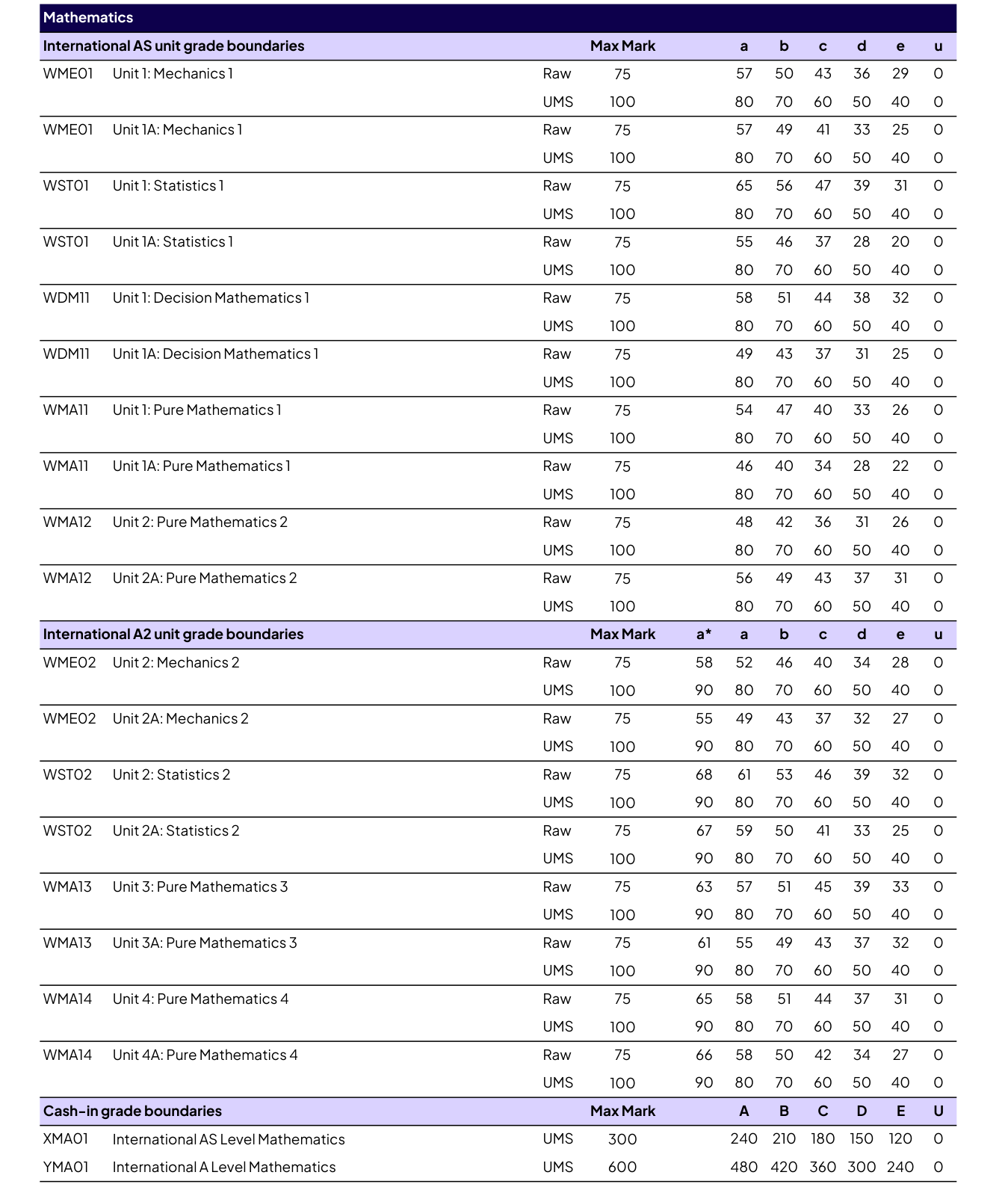
每次考季后 Pearson 按当次试卷难度公布各单元的 Raw(原始分)分界;UMS 分界固定不变(AS 单元 a–e 对应 80/70/60/50/40,A2 单元另设 a* = 90)。表中同一单元的两行(如 Unit 1 与 Unit 1A)为同一份试卷的不同版本,Raw 分界不同、UMS 分界相同,具体以考生所考版本为准。
📍 2026年6月考季
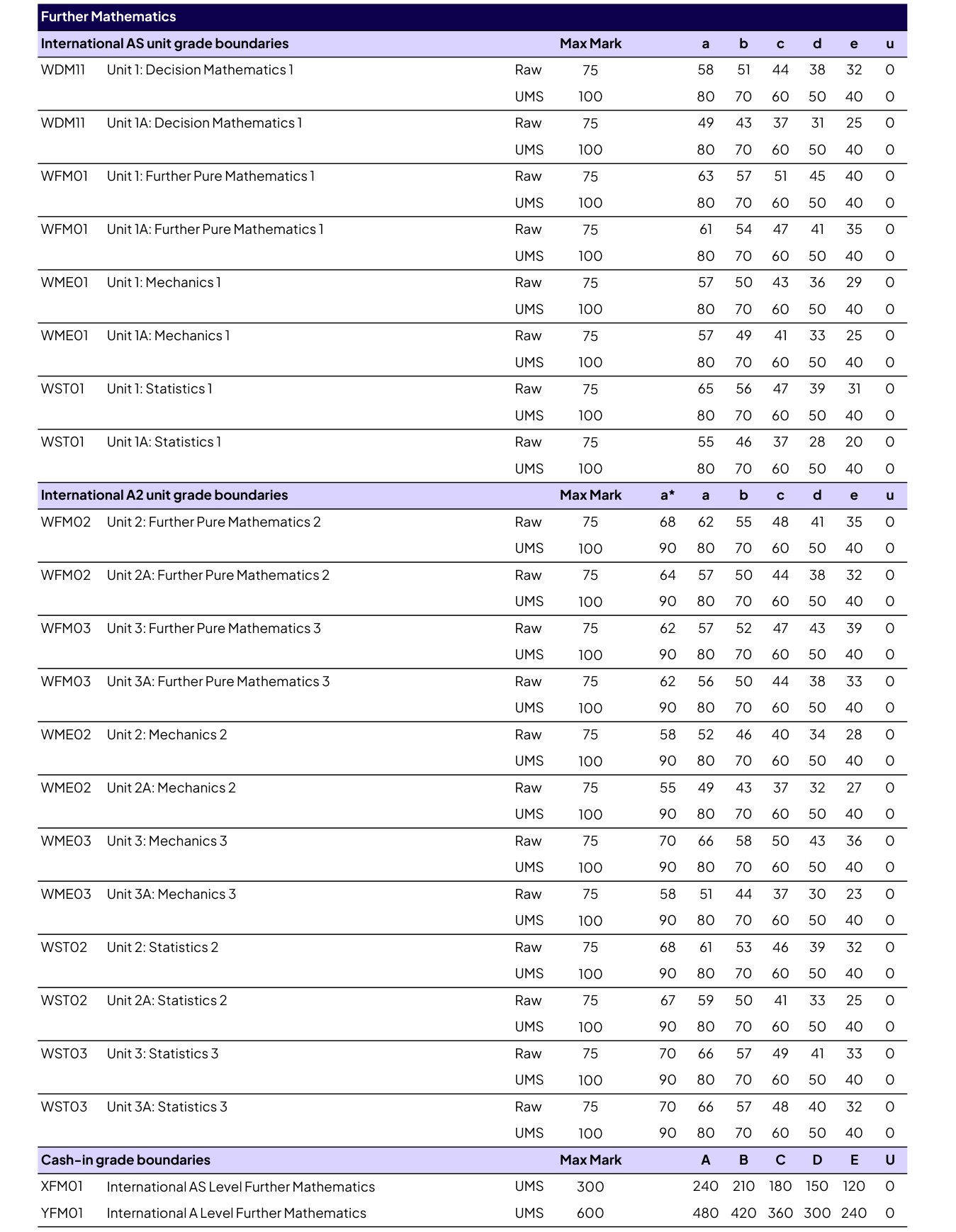
📍 2026年1月考季
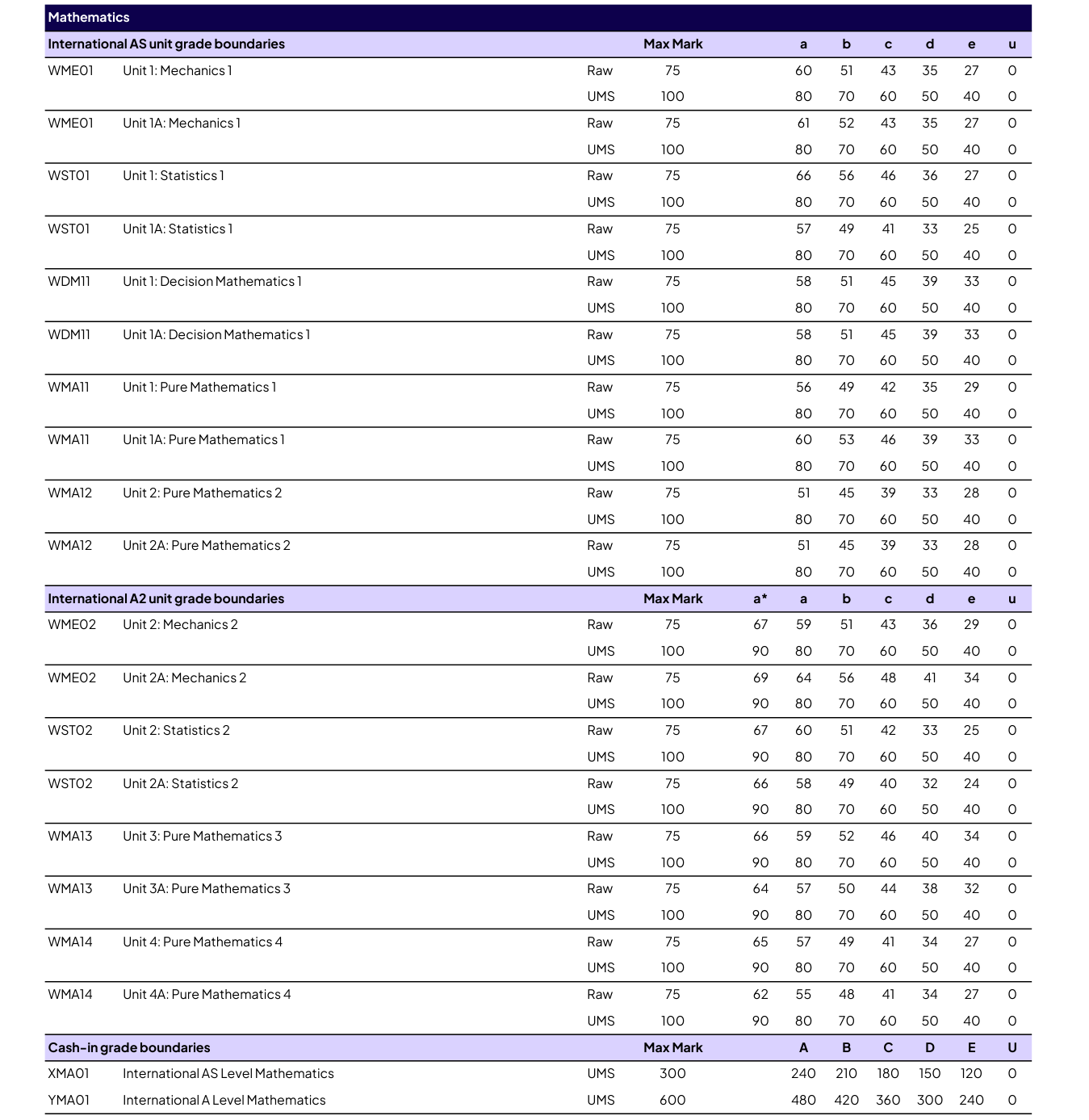
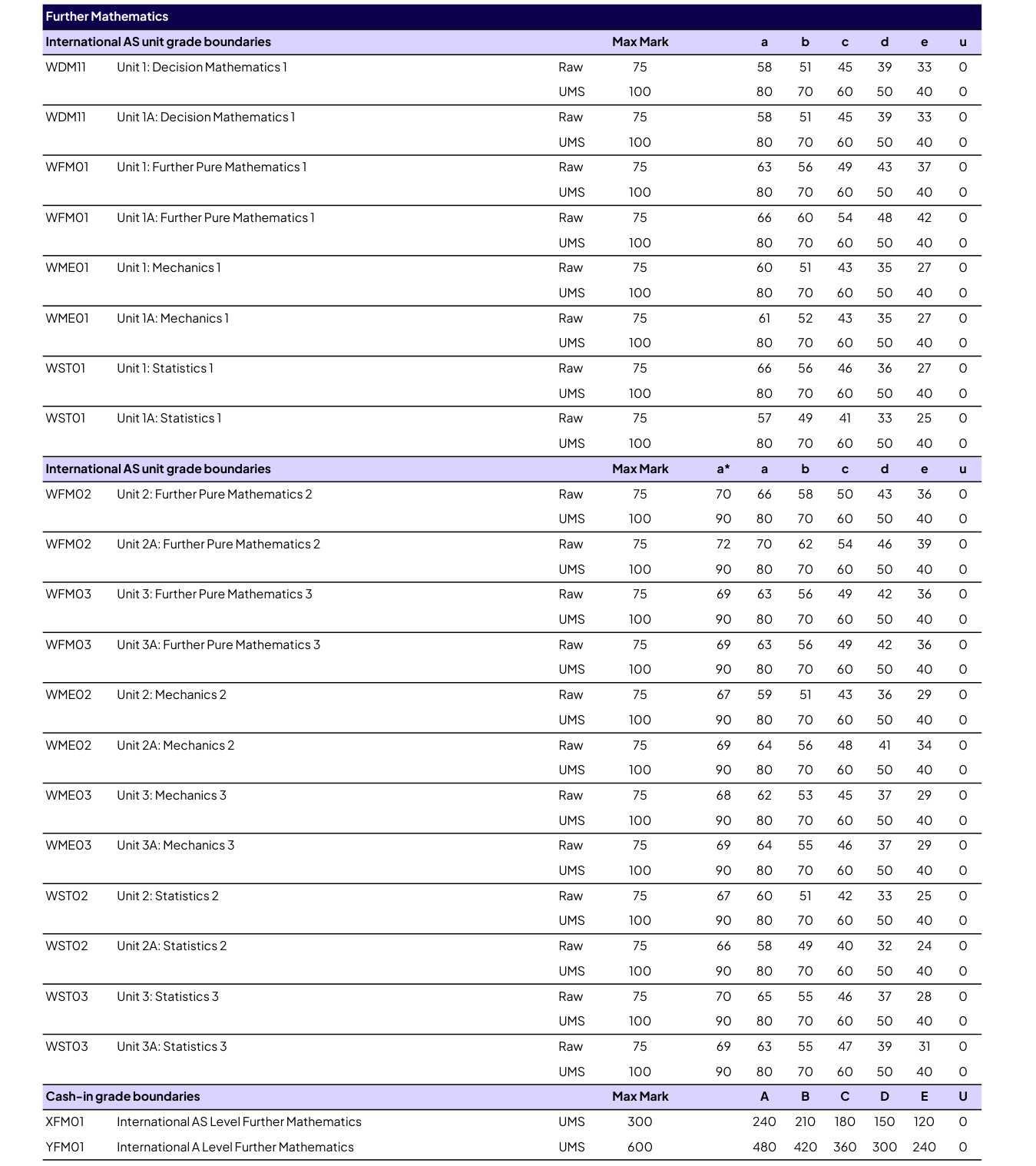
📍 2025年10月考季
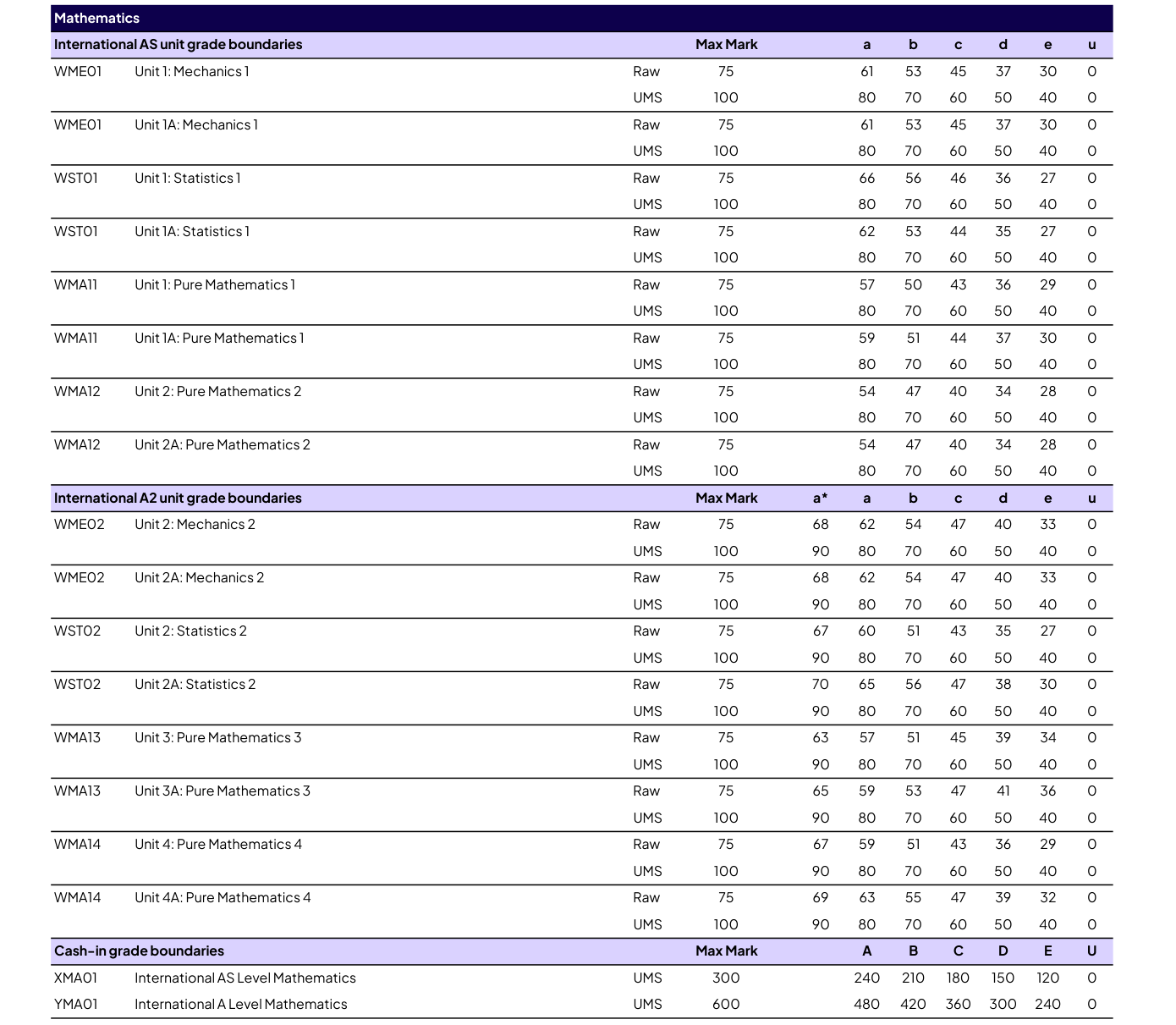
截图来源:qualifications.pearson.com 官方「Grade boundaries — International A Level」文件(2026 年 6 月 / 2026 年 1 月 / 2025 年 10 月考季)。2025 年 10 月考季官方文件未含进阶数学段落(该考季未开放相应单元)。
📝 FP3 分类真题 Categorised Past Papers
Edexcel IAL WFM03 (FP3) 2019–2026 共 15 卷 / 124 题(含 01a 区域变体), 按站点 7 个章节、32 个知识点双语分类。点开任一知识点即可看到对应年份的真题; 每题附「题目 Question」与「详解 Mark Scheme」两个链接,均为所在完整试卷页原版(PDF 整页,不裁剪)。
同一知识点可能出现在多个章节之下(各章只列属于该章的题)。
1 · 双曲函数 Hyperbolic Functions (17 题)
双曲函数求值与恒等式 Hyperbolic identities and evaluation (8 题)
| 试卷 Session | 题号 | 分值 | 链接 Links |
|---|---|---|---|
| 2019 Jun | Q2 | 9 | 题目 Question · 详解 Mark Scheme |
| 2020 Oct | Q1 | 7 | 题目 Question · 详解 Mark Scheme |
| 2021 Jun | Q1 | 6 | 题目 Question · 详解 Mark Scheme |
| 2022 Jan | Q1 | 8 | 题目 Question · 详解 Mark Scheme |
| 2022 Jun | Q1 | 7 | 题目 Question · 详解 Mark Scheme |
| 2024 Jun | Q4 | 9 | 题目 Question · 详解 Mark Scheme |
| 2025 Jun | Q1 | 6 | 题目 Question · 详解 Mark Scheme |
| 2026 Jan | Q3 | 8 | 题目 Question · 详解 Mark Scheme |
反双曲函数 Inverse hyperbolic functions (3 题)
| 试卷 Session | 题号 | 分值 | 链接 Links |
|---|---|---|---|
| 2019 Jun | Q3 | 7 | 题目 Question · 详解 Mark Scheme |
| 2020 Oct | Q2 | 8 | 题目 Question · 详解 Mark Scheme |
| 2022 Jan | Q5 | 7 | 题目 Question · 详解 Mark Scheme |
反双曲函数的对数形式 Logarithmic forms of inverse hyperbolic functions (7 题)
| 试卷 Session | 题号 | 分值 | 链接 Links |
|---|---|---|---|
| 2019 Jun | Q2 | 9 | 题目 Question · 详解 Mark Scheme |
| 2020 Oct | Q1 | 7 | 题目 Question · 详解 Mark Scheme |
| 2021 Jun | Q1 | 6 | 题目 Question · 详解 Mark Scheme |
| 2021 Jun | Q7 | 8 | 题目 Question · 详解 Mark Scheme |
| 2022 Jan | Q1 | 8 | 题目 Question · 详解 Mark Scheme |
| 2022 Jun | Q1 | 7 | 题目 Question · 详解 Mark Scheme |
| 2026 Jan 01A | Q1 | 7 | 题目 Question · 详解 Mark Scheme |
双曲方程求解 Solving hyperbolic equations (12 题)
| 试卷 Session | 题号 | 分值 | 链接 Links |
|---|---|---|---|
| 2019 Jun | Q2 | 9 | 题目 Question · 详解 Mark Scheme |
| 2020 Oct | Q1 | 7 | 题目 Question · 详解 Mark Scheme |
| 2021 Jun | Q1 | 6 | 题目 Question · 详解 Mark Scheme |
| 2022 Jan | Q1 | 8 | 题目 Question · 详解 Mark Scheme |
| 2022 Jun | Q1 | 7 | 题目 Question · 详解 Mark Scheme |
| 2023 Jan | Q3 | 6 | 题目 Question · 详解 Mark Scheme |
| 2023 Jun | Q1 | 5 | 题目 Question · 详解 Mark Scheme |
| 2024 Jun | Q4 | 9 | 题目 Question · 详解 Mark Scheme |
| 2025 Jan | Q1 | 6 | 题目 Question · 详解 Mark Scheme |
| 2025 Jun | Q1 | 6 | 题目 Question · 详解 Mark Scheme |
| 2026 Jan | Q3 | 8 | 题目 Question · 详解 Mark Scheme |
| 2026 Jan 01A | Q1 | 7 | 题目 Question · 详解 Mark Scheme |
标准积分 Standard integrals (5 题)
| 试卷 Session | 题号 | 分值 | 链接 Links |
|---|---|---|---|
| 2019 Jun | Q3 | 7 | 题目 Question · 详解 Mark Scheme |
| 2020 Oct | Q2 | 8 | 题目 Question · 详解 Mark Scheme |
| 2021 Jun | Q7 | 8 | 题目 Question · 详解 Mark Scheme |
| 2022 Jan | Q5 | 7 | 题目 Question · 详解 Mark Scheme |
| 2022 Jun | Q2 | 9 | 题目 Question · 详解 Mark Scheme |
2 · 进阶坐标系 Further Coordinate Systems (21 题)
椭圆 The ellipse (11 题)
| 试卷 Session | 题号 | 分值 | 链接 Links |
|---|---|---|---|
| 2019 Jun | Q8 | 11 | 题目 Question · 详解 Mark Scheme |
| 2022 Jan | Q8 | 13 | 题目 Question · 详解 Mark Scheme |
| 2022 Jun | Q9 | 10 | 题目 Question · 详解 Mark Scheme |
| 2023 Jan | Q9 | 13 | 题目 Question · 详解 Mark Scheme |
| 2023 Jun | Q6 | 13 | 题目 Question · 详解 Mark Scheme |
| 2024 Jan | Q3 | 11 | 题目 Question · 详解 Mark Scheme |
| 2024 Jun | Q6 | 9 | 题目 Question · 详解 Mark Scheme |
| 2025 Jan | Q7 | 12 | 题目 Question · 详解 Mark Scheme |
| 2026 Jan | Q8 | 9 | 题目 Question · 详解 Mark Scheme |
| 2026 Jun | Q2 | 10 | 题目 Question · 详解 Mark Scheme |
| 2026 Jun 01A | Q7 | 14 | 题目 Question · 详解 Mark Scheme |
双曲线 The hyperbola (10 题)
| 试卷 Session | 题号 | 分值 | 链接 Links |
|---|---|---|---|
| 2019 Jun | Q1 | 6 | 题目 Question · 详解 Mark Scheme |
| 2020 Oct | Q5 | 12 | 题目 Question · 详解 Mark Scheme |
| 2021 Jun | Q8 | 14 | 题目 Question · 详解 Mark Scheme |
| 2023 Jan | Q2 | 6 | 题目 Question · 详解 Mark Scheme |
| 2024 Jun | Q1 | 6 | 题目 Question · 详解 Mark Scheme |
| 2025 Jan | Q2 | 6 | 题目 Question · 详解 Mark Scheme |
| 2025 Jun | Q9 | 12 | 题目 Question · 详解 Mark Scheme |
| 2026 Jan | Q1 | 5 | 题目 Question · 详解 Mark Scheme |
| 2026 Jan 01A | Q3 | 11 | 题目 Question · 详解 Mark Scheme |
| 2026 Jun 01A | Q1 | 8 | 题目 Question · 详解 Mark Scheme |
参数方程 Parametric equations (9 题)
| 试卷 Session | 题号 | 分值 | 链接 Links |
|---|---|---|---|
| 2021 Jun | Q8 | 14 | 题目 Question · 详解 Mark Scheme |
| 2022 Jan | Q8 | 13 | 题目 Question · 详解 Mark Scheme |
| 2023 Jun | Q6 | 13 | 题目 Question · 详解 Mark Scheme |
| 2024 Jun | Q6 | 9 | 题目 Question · 详解 Mark Scheme |
| 2025 Jan | Q7 | 12 | 题目 Question · 详解 Mark Scheme |
| 2025 Jun | Q9 | 12 | 题目 Question · 详解 Mark Scheme |
| 2026 Jan | Q8 | 9 | 题目 Question · 详解 Mark Scheme |
| 2026 Jun 01A | Q1 | 8 | 题目 Question · 详解 Mark Scheme |
| 2026 Jun 01A | Q7 | 14 | 题目 Question · 详解 Mark Scheme |
切线与法线 Tangents and normals (11 题)
| 试卷 Session | 题号 | 分值 | 链接 Links |
|---|---|---|---|
| 2019 Jun | Q8 | 11 | 题目 Question · 详解 Mark Scheme |
| 2020 Oct | Q5 | 12 | 题目 Question · 详解 Mark Scheme |
| 2021 Jun | Q8 | 14 | 题目 Question · 详解 Mark Scheme |
| 2022 Jan | Q8 | 13 | 题目 Question · 详解 Mark Scheme |
| 2023 Jun | Q6 | 13 | 题目 Question · 详解 Mark Scheme |
| 2024 Jun | Q6 | 9 | 题目 Question · 详解 Mark Scheme |
| 2025 Jan | Q7 | 12 | 题目 Question · 详解 Mark Scheme |
| 2025 Jun | Q9 | 12 | 题目 Question · 详解 Mark Scheme |
| 2026 Jan | Q8 | 9 | 题目 Question · 详解 Mark Scheme |
| 2026 Jan 01A | Q3 | 11 | 题目 Question · 详解 Mark Scheme |
| 2026 Jun 01A | Q1 | 8 | 题目 Question · 详解 Mark Scheme |
轨迹方程 Finding loci (6 题)
| 试卷 Session | 题号 | 分值 | 链接 Links |
|---|---|---|---|
| 2021 Jun | Q8 | 14 | 题目 Question · 详解 Mark Scheme |
| 2022 Jan | Q8 | 13 | 题目 Question · 详解 Mark Scheme |
| 2022 Jun | Q9 | 10 | 题目 Question · 详解 Mark Scheme |
| 2023 Jan | Q9 | 13 | 题目 Question · 详解 Mark Scheme |
| 2023 Jun | Q6 | 13 | 题目 Question · 详解 Mark Scheme |
| 2026 Jun | Q2 | 10 | 题目 Question · 详解 Mark Scheme |
离心率与焦点 Eccentricity and foci (13 题)
| 试卷 Session | 题号 | 分值 | 链接 Links |
|---|---|---|---|
| 2019 Jun | Q1 | 6 | 题目 Question · 详解 Mark Scheme |
| 2021 Jun | Q8 | 14 | 题目 Question · 详解 Mark Scheme |
| 2022 Jan | Q8 | 13 | 题目 Question · 详解 Mark Scheme |
| 2023 Jan | Q2 | 6 | 题目 Question · 详解 Mark Scheme |
| 2023 Jan | Q9 | 13 | 题目 Question · 详解 Mark Scheme |
| 2024 Jan | Q3 | 11 | 题目 Question · 详解 Mark Scheme |
| 2024 Jun | Q1 | 6 | 题目 Question · 详解 Mark Scheme |
| 2025 Jan | Q2 | 6 | 题目 Question · 详解 Mark Scheme |
| 2025 Jun | Q9 | 12 | 题目 Question · 详解 Mark Scheme |
| 2026 Jan | Q1 | 5 | 题目 Question · 详解 Mark Scheme |
| 2026 Jan 01A | Q3 | 11 | 题目 Question · 详解 Mark Scheme |
| 2026 Jun | Q2 | 10 | 题目 Question · 详解 Mark Scheme |
| 2026 Jun 01A | Q7 | 14 | 题目 Question · 详解 Mark Scheme |
旋转曲面面积 Area of surface of revolution (1 题)
| 试卷 Session | 题号 | 分值 | 链接 Links |
|---|---|---|---|
| 2026 Jun 01A | Q7 | 14 | 题目 Question · 详解 Mark Scheme |
3 · 微分法 Differentiation (13 题)
双曲函数的导数 Derivatives of hyperbolic functions (5 题)
| 试卷 Session | 题号 | 分值 | 链接 Links |
|---|---|---|---|
| 2021 Jun | Q4 | 8 | 题目 Question · 详解 Mark Scheme |
| 2024 Jan | Q7 | 9 | 题目 Question · 详解 Mark Scheme |
| 2025 Jan | Q8 | 6 | 题目 Question · 详解 Mark Scheme |
| 2026 Jun | Q3 | 7 | 题目 Question · 详解 Mark Scheme |
| 2026 Jun 01A | Q4 | 9 | 题目 Question · 详解 Mark Scheme |
反函数的导数 Derivatives of inverse functions (10 题)
| 试卷 Session | 题号 | 分值 | 链接 Links |
|---|---|---|---|
| 2021 Jun | Q4 | 8 | 题目 Question · 详解 Mark Scheme |
| 2022 Jan | Q3 | 9 | 题目 Question · 详解 Mark Scheme |
| 2022 Jun | Q4 | 4 | 题目 Question · 详解 Mark Scheme |
| 2023 Jan | Q1 | 3 | 题目 Question · 详解 Mark Scheme |
| 2023 Jun | Q8 | 10 | 题目 Question · 详解 Mark Scheme |
| 2024 Jan | Q7 | 9 | 题目 Question · 详解 Mark Scheme |
| 2024 Jun | Q3 | 7 | 题目 Question · 详解 Mark Scheme |
| 2025 Jun | Q4 | 5 | 题目 Question · 详解 Mark Scheme |
| 2026 Jan | Q9 | 6 | 题目 Question · 详解 Mark Scheme |
| 2026 Jun 01A | Q2 | 8 | 题目 Question · 详解 Mark Scheme |
双曲函数求值与恒等式 Hyperbolic identities and evaluation (1 题)
| 试卷 Session | 题号 | 分值 | 链接 Links |
|---|---|---|---|
| 2026 Jun | Q3 | 7 | 题目 Question · 详解 Mark Scheme |
反双曲函数 Inverse hyperbolic functions (3 题)
| 试卷 Session | 题号 | 分值 | 链接 Links |
|---|---|---|---|
| 2023 Jun | Q8 | 10 | 题目 Question · 详解 Mark Scheme |
| 2026 Jan | Q9 | 6 | 题目 Question · 详解 Mark Scheme |
| 2026 Jun 01A | Q2 | 8 | 题目 Question · 详解 Mark Scheme |
反双曲函数的对数形式 Logarithmic forms of inverse hyperbolic functions (2 题)
| 试卷 Session | 题号 | 分值 | 链接 Links |
|---|---|---|---|
| 2025 Jun | Q4 | 5 | 题目 Question · 详解 Mark Scheme |
| 2026 Jun 01A | Q4 | 9 | 题目 Question · 详解 Mark Scheme |
4 · 积分法 Integration (35 题)
约化公式 Reduction formulae (14 题)
| 试卷 Session | 题号 | 分值 | 链接 Links |
|---|---|---|---|
| 2019 Jun | Q7 | 10 | 题目 Question · 详解 Mark Scheme |
| 2020 Oct | Q4 | 9 | 题目 Question · 详解 Mark Scheme |
| 2021 Jun | Q5 | 10 | 题目 Question · 详解 Mark Scheme |
| 2022 Jan | Q6 | 10 | 题目 Question · 详解 Mark Scheme |
| 2022 Jun | Q7 | 10 | 题目 Question · 详解 Mark Scheme |
| 2023 Jan | Q8 | 11 | 题目 Question · 详解 Mark Scheme |
| 2023 Jun | Q7 | 9 | 题目 Question · 详解 Mark Scheme |
| 2024 Jan | Q5 | 11 | 题目 Question · 详解 Mark Scheme |
| 2024 Jun | Q8 | 9 | 题目 Question · 详解 Mark Scheme |
| 2025 Jun | Q5 | 9 | 题目 Question · 详解 Mark Scheme |
| 2026 Jan | Q7 | 9 | 题目 Question · 详解 Mark Scheme |
| 2026 Jan 01A | Q4 | 10 | 题目 Question · 详解 Mark Scheme |
| 2026 Jun | Q8 | 9 | 题目 Question · 详解 Mark Scheme |
| 2026 Jun 01A | Q8 | 11 | 题目 Question · 详解 Mark Scheme |
弧长 Arc length (8 题)
| 试卷 Session | 题号 | 分值 | 链接 Links |
|---|---|---|---|
| 2019 Jun | Q4 | 9 | 题目 Question · 详解 Mark Scheme |
| 2021 Jun | Q2 | 7 | 题目 Question · 详解 Mark Scheme |
| 2023 Jun | Q3 | 11 | 题目 Question · 详解 Mark Scheme |
| 2024 Jan | Q8 | 9 | 题目 Question · 详解 Mark Scheme |
| 2024 Jun | Q7 | 8 | 题目 Question · 详解 Mark Scheme |
| 2025 Jan | Q5 | 11 | 题目 Question · 详解 Mark Scheme |
| 2026 Jan | Q5 | 12 | 题目 Question · 详解 Mark Scheme |
| 2026 Jun | Q4 | 11 | 题目 Question · 详解 Mark Scheme |
旋转曲面面积 Area of surface of revolution (10 题)
| 试卷 Session | 题号 | 分值 | 链接 Links |
|---|---|---|---|
| 2020 Oct | Q7 | 12 | 题目 Question · 详解 Mark Scheme |
| 2021 Jun | Q2 | 7 | 题目 Question · 详解 Mark Scheme |
| 2022 Jan | Q2 | 8 | 题目 Question · 详解 Mark Scheme |
| 2022 Jun | Q5 | 7 | 题目 Question · 详解 Mark Scheme |
| 2023 Jan | Q6 | 9 | 题目 Question · 详解 Mark Scheme |
| 2025 Jan | Q5 | 11 | 题目 Question · 详解 Mark Scheme |
| 2025 Jun | Q7 | 9 | 题目 Question · 详解 Mark Scheme |
| 2026 Jan | Q5 | 12 | 题目 Question · 详解 Mark Scheme |
| 2026 Jan 01A | Q6 | 12 | 题目 Question · 详解 Mark Scheme |
| 2026 Jun | Q4 | 11 | 题目 Question · 详解 Mark Scheme |
反三角函数积分 Inverse trigonometric integrals (2 题)
| 试卷 Session | 题号 | 分值 | 链接 Links |
|---|---|---|---|
| 2024 Jan | Q1 | 7 | 题目 Question · 详解 Mark Scheme |
| 2025 Jan | Q3 | 10 | 题目 Question · 详解 Mark Scheme |
双曲函数求值与恒等式 Hyperbolic identities and evaluation (3 题)
| 试卷 Session | 题号 | 分值 | 链接 Links |
|---|---|---|---|
| 2024 Jan | Q5 | 11 | 题目 Question · 详解 Mark Scheme |
| 2024 Jun | Q7 | 8 | 题目 Question · 详解 Mark Scheme |
| 2025 Jun | Q7 | 9 | 题目 Question · 详解 Mark Scheme |
反双曲函数 Inverse hyperbolic functions (7 题)
| 试卷 Session | 题号 | 分值 | 链接 Links |
|---|---|---|---|
| 2023 Jan | Q4 | 5 | 题目 Question · 详解 Mark Scheme |
| 2024 Jan | Q8 | 9 | 题目 Question · 详解 Mark Scheme |
| 2024 Jun | Q5 | 8 | 题目 Question · 详解 Mark Scheme |
| 2025 Jan | Q3 | 10 | 题目 Question · 详解 Mark Scheme |
| 2025 Jun | Q2 | 7 | 题目 Question · 详解 Mark Scheme |
| 2026 Jan 01A | Q2 | 12 | 题目 Question · 详解 Mark Scheme |
| 2026 Jun | Q6 | 9 | 题目 Question · 详解 Mark Scheme |
反双曲函数的对数形式 Logarithmic forms of inverse hyperbolic functions (4 题)
| 试卷 Session | 题号 | 分值 | 链接 Links |
|---|---|---|---|
| 2019 Jun | Q4 | 9 | 题目 Question · 详解 Mark Scheme |
| 2025 Jun | Q2 | 7 | 题目 Question · 详解 Mark Scheme |
| 2026 Jan 01A | Q2 | 12 | 题目 Question · 详解 Mark Scheme |
| 2026 Jun | Q6 | 9 | 题目 Question · 详解 Mark Scheme |
双曲函数的导数 Derivatives of hyperbolic functions (1 题)
| 试卷 Session | 题号 | 分值 | 链接 Links |
|---|---|---|---|
| 2020 Oct | Q7 | 12 | 题目 Question · 详解 Mark Scheme |
参数微分 Parametric differentiation (8 题)
| 试卷 Session | 题号 | 分值 | 链接 Links |
|---|---|---|---|
| 2020 Oct | Q7 | 12 | 题目 Question · 详解 Mark Scheme |
| 2022 Jan | Q2 | 8 | 题目 Question · 详解 Mark Scheme |
| 2022 Jun | Q5 | 7 | 题目 Question · 详解 Mark Scheme |
| 2023 Jan | Q6 | 9 | 题目 Question · 详解 Mark Scheme |
| 2025 Jan | Q5 | 11 | 题目 Question · 详解 Mark Scheme |
| 2026 Jan | Q5 | 12 | 题目 Question · 详解 Mark Scheme |
| 2026 Jan 01A | Q6 | 12 | 题目 Question · 详解 Mark Scheme |
| 2026 Jun | Q4 | 11 | 题目 Question · 详解 Mark Scheme |
5 · 向量 Vectors (15 题)
直线方程 Equation of a line (7 题)
| 试卷 Session | 题号 | 分值 | 链接 Links |
|---|---|---|---|
| 2020 Oct | Q8 | 10 | 题目 Question · 详解 Mark Scheme |
| 2021 Jun | Q6 | 13 | 题目 Question · 详解 Mark Scheme |
| 2022 Jan | Q7 | 11 | 题目 Question · 详解 Mark Scheme |
| 2022 Jun | Q8 | 12 | 题目 Question · 详解 Mark Scheme |
| 2023 Jun | Q4 | 12 | 题目 Question · 详解 Mark Scheme |
| 2024 Jan | Q6 | 12 | 题目 Question · 详解 Mark Scheme |
| 2025 Jun | Q8 | 10 | 题目 Question · 详解 Mark Scheme |
平面方程 Equation of a plane (14 题)
| 试卷 Session | 题号 | 分值 | 链接 Links |
|---|---|---|---|
| 2019 Jun | Q5 | 10 | 题目 Question · 详解 Mark Scheme |
| 2020 Oct | Q8 | 10 | 题目 Question · 详解 Mark Scheme |
| 2021 Jun | Q6 | 13 | 题目 Question · 详解 Mark Scheme |
| 2022 Jan | Q7 | 11 | 题目 Question · 详解 Mark Scheme |
| 2022 Jun | Q8 | 12 | 题目 Question · 详解 Mark Scheme |
| 2023 Jan | Q7 | 10 | 题目 Question · 详解 Mark Scheme |
| 2023 Jun | Q4 | 12 | 题目 Question · 详解 Mark Scheme |
| 2024 Jan | Q6 | 12 | 题目 Question · 详解 Mark Scheme |
| 2024 Jun | Q9 | 10 | 题目 Question · 详解 Mark Scheme |
| 2025 Jan | Q6 | 10 | 题目 Question · 详解 Mark Scheme |
| 2025 Jun | Q8 | 10 | 题目 Question · 详解 Mark Scheme |
| 2026 Jan 01A | Q7 | 12 | 题目 Question · 详解 Mark Scheme |
| 2026 Jun | Q7 | 10 | 题目 Question · 详解 Mark Scheme |
| 2026 Jun 01A | Q5 | 9 | 题目 Question · 详解 Mark Scheme |
直线与平面夹角 Angles between lines and planes (5 题)
| 试卷 Session | 题号 | 分值 | 链接 Links |
|---|---|---|---|
| 2019 Jun | Q5 | 10 | 题目 Question · 详解 Mark Scheme |
| 2021 Jun | Q6 | 13 | 题目 Question · 详解 Mark Scheme |
| 2022 Jan | Q7 | 11 | 题目 Question · 详解 Mark Scheme |
| 2023 Jan | Q7 | 10 | 题目 Question · 详解 Mark Scheme |
| 2025 Jan | Q6 | 10 | 题目 Question · 详解 Mark Scheme |
直线与平面相交 Intersection of lines and planes (5 题)
| 试卷 Session | 题号 | 分值 | 链接 Links |
|---|---|---|---|
| 2022 Jan | Q7 | 11 | 题目 Question · 详解 Mark Scheme |
| 2022 Jun | Q8 | 12 | 题目 Question · 详解 Mark Scheme |
| 2023 Jun | Q4 | 12 | 题目 Question · 详解 Mark Scheme |
| 2024 Jun | Q9 | 10 | 题目 Question · 详解 Mark Scheme |
| 2025 Jun | Q8 | 10 | 题目 Question · 详解 Mark Scheme |
点到平面距离 Distance from point to plane (8 题)
| 试卷 Session | 题号 | 分值 | 链接 Links |
|---|---|---|---|
| 2019 Jun | Q5 | 10 | 题目 Question · 详解 Mark Scheme |
| 2023 Jan | Q7 | 10 | 题目 Question · 详解 Mark Scheme |
| 2024 Jan | Q6 | 12 | 题目 Question · 详解 Mark Scheme |
| 2025 Jan | Q6 | 10 | 题目 Question · 详解 Mark Scheme |
| 2026 Jan | Q4 | 8 | 题目 Question · 详解 Mark Scheme |
| 2026 Jan 01A | Q7 | 12 | 题目 Question · 详解 Mark Scheme |
| 2026 Jun | Q7 | 10 | 题目 Question · 详解 Mark Scheme |
| 2026 Jun 01A | Q5 | 9 | 题目 Question · 详解 Mark Scheme |
向量积与混合积 Vector and scalar triple products (11 题)
| 试卷 Session | 题号 | 分值 | 链接 Links |
|---|---|---|---|
| 2021 Jun | Q6 | 13 | 题目 Question · 详解 Mark Scheme |
| 2023 Jan | Q7 | 10 | 题目 Question · 详解 Mark Scheme |
| 2023 Jun | Q4 | 12 | 题目 Question · 详解 Mark Scheme |
| 2024 Jan | Q6 | 12 | 题目 Question · 详解 Mark Scheme |
| 2024 Jun | Q9 | 10 | 题目 Question · 详解 Mark Scheme |
| 2025 Jan | Q6 | 10 | 题目 Question · 详解 Mark Scheme |
| 2025 Jun | Q8 | 10 | 题目 Question · 详解 Mark Scheme |
| 2026 Jan | Q4 | 8 | 题目 Question · 详解 Mark Scheme |
| 2026 Jan 01A | Q7 | 12 | 题目 Question · 详解 Mark Scheme |
| 2026 Jun | Q7 | 10 | 题目 Question · 详解 Mark Scheme |
| 2026 Jun 01A | Q5 | 9 | 题目 Question · 详解 Mark Scheme |
异面直线间距离 Distance between skew lines (1 题)
| 试卷 Session | 题号 | 分值 | 链接 Links |
|---|---|---|---|
| 2025 Jun | Q8 | 10 | 题目 Question · 详解 Mark Scheme |
平行线间距离 Distance between parallel lines (1 题)
| 试卷 Session | 题号 | 分值 | 链接 Links |
|---|---|---|---|
| 2020 Oct | Q8 | 10 | 题目 Question · 详解 Mark Scheme |
6 · 矩阵 Matrices (10 题)
矩阵运算 Matrix operations (8 题)
| 试卷 Session | 题号 | 分值 | 链接 Links |
|---|---|---|---|
| 2020 Oct | Q6 | 8 | 题目 Question · 详解 Mark Scheme |
| 2021 Jun | Q3 | 9 | 题目 Question · 详解 Mark Scheme |
| 2022 Jun | Q6 | 8 | 题目 Question · 详解 Mark Scheme |
| 2023 Jun | Q2 | 8 | 题目 Question · 详解 Mark Scheme |
| 2024 Jan | Q2 | 8 | 题目 Question · 详解 Mark Scheme |
| 2026 Jan | Q2 | 7 | 题目 Question · 详解 Mark Scheme |
| 2026 Jun | Q5 | 11 | 题目 Question · 详解 Mark Scheme |
| 2026 Jun 01A | Q6 | 8 | 题目 Question · 详解 Mark Scheme |
逆矩阵 Inverse matrices (9 题)
| 试卷 Session | 题号 | 分值 | 链接 Links |
|---|---|---|---|
| 2020 Oct | Q6 | 8 | 题目 Question · 详解 Mark Scheme |
| 2021 Jun | Q3 | 9 | 题目 Question · 详解 Mark Scheme |
| 2022 Jun | Q6 | 8 | 题目 Question · 详解 Mark Scheme |
| 2023 Jun | Q2 | 8 | 题目 Question · 详解 Mark Scheme |
| 2024 Jan | Q2 | 8 | 题目 Question · 详解 Mark Scheme |
| 2025 Jun | Q6 | 7 | 题目 Question · 详解 Mark Scheme |
| 2026 Jan | Q2 | 7 | 题目 Question · 详解 Mark Scheme |
| 2026 Jan 01A | Q5 | 11 | 题目 Question · 详解 Mark Scheme |
| 2026 Jun 01A | Q6 | 8 | 题目 Question · 详解 Mark Scheme |
行列式 Determinants (5 题)
| 试卷 Session | 题号 | 分值 | 链接 Links |
|---|---|---|---|
| 2021 Jun | Q3 | 9 | 题目 Question · 详解 Mark Scheme |
| 2022 Jun | Q6 | 8 | 题目 Question · 详解 Mark Scheme |
| 2025 Jun | Q6 | 7 | 题目 Question · 详解 Mark Scheme |
| 2026 Jan | Q2 | 7 | 题目 Question · 详解 Mark Scheme |
| 2026 Jun | Q5 | 11 | 题目 Question · 详解 Mark Scheme |
直线方程 Equation of a line (1 题)
| 试卷 Session | 题号 | 分值 | 链接 Links |
|---|---|---|---|
| 2020 Oct | Q6 | 8 | 题目 Question · 详解 Mark Scheme |
平面方程 Equation of a plane (1 题)
| 试卷 Session | 题号 | 分值 | 链接 Links |
|---|---|---|---|
| 2026 Jan 01A | Q5 | 11 | 题目 Question · 详解 Mark Scheme |
向量积与混合积 Vector and scalar triple products (1 题)
| 试卷 Session | 题号 | 分值 | 链接 Links |
|---|---|---|---|
| 2020 Oct | Q6 | 8 | 题目 Question · 详解 Mark Scheme |
7 · 特征值与特征向量 Eigenvalues and Eigenvectors (13 题)
特征值与特征向量 Eigenvalues and eigenvectors (13 题)
| 试卷 Session | 题号 | 分值 | 链接 Links |
|---|---|---|---|
| 2019 Jun | Q6 | 13 | 题目 Question · 详解 Mark Scheme |
| 2020 Oct | Q3 | 9 | 题目 Question · 详解 Mark Scheme |
| 2022 Jan | Q4 | 9 | 题目 Question · 详解 Mark Scheme |
| 2022 Jun | Q3 | 8 | 题目 Question · 详解 Mark Scheme |
| 2023 Jan | Q5 | 12 | 题目 Question · 详解 Mark Scheme |
| 2023 Jun | Q5 | 7 | 题目 Question · 详解 Mark Scheme |
| 2024 Jan | Q4 | 8 | 题目 Question · 详解 Mark Scheme |
| 2024 Jun | Q2 | 9 | 题目 Question · 详解 Mark Scheme |
| 2025 Jan | Q4 | 14 | 题目 Question · 详解 Mark Scheme |
| 2025 Jun | Q3 | 10 | 题目 Question · 详解 Mark Scheme |
| 2026 Jan | Q6 | 11 | 题目 Question · 详解 Mark Scheme |
| 2026 Jun | Q1 | 8 | 题目 Question · 详解 Mark Scheme |
| 2026 Jun 01A | Q3 | 8 | 题目 Question · 详解 Mark Scheme |
对角化 Diagonalisation (3 题)
| 试卷 Session | 题号 | 分值 | 链接 Links |
|---|---|---|---|
| 2022 Jun | Q3 | 8 | 题目 Question · 详解 Mark Scheme |
| 2024 Jan | Q4 | 8 | 题目 Question · 详解 Mark Scheme |
| 2025 Jan | Q4 | 14 | 题目 Question · 详解 Mark Scheme |
对称矩阵与正交对角化 Orthogonal diagonalisation of symmetric matrices (5 题)
| 试卷 Session | 题号 | 分值 | 链接 Links |
|---|---|---|---|
| 2022 Jun | Q3 | 8 | 题目 Question · 详解 Mark Scheme |
| 2023 Jan | Q5 | 12 | 题目 Question · 详解 Mark Scheme |
| 2024 Jan | Q4 | 8 | 题目 Question · 详解 Mark Scheme |
| 2025 Jan | Q4 | 14 | 题目 Question · 详解 Mark Scheme |
| 2026 Jun | Q1 | 8 | 题目 Question · 详解 Mark Scheme |
直线方程 Equation of a line (3 题)
| 试卷 Session | 题号 | 分值 | 链接 Links |
|---|---|---|---|
| 2019 Jun | Q6 | 13 | 题目 Question · 详解 Mark Scheme |
| 2024 Jun | Q2 | 9 | 题目 Question · 详解 Mark Scheme |
| 2026 Jan | Q6 | 11 | 题目 Question · 详解 Mark Scheme |
向量积与混合积 Vector and scalar triple products (2 题)
| 试卷 Session | 题号 | 分值 | 链接 Links |
|---|---|---|---|
| 2019 Jun | Q6 | 13 | 题目 Question · 详解 Mark Scheme |
| 2024 Jun | Q2 | 9 | 题目 Question · 详解 Mark Scheme |
行列式 Determinants (2 题)
| 试卷 Session | 题号 | 分值 | 链接 Links |
|---|---|---|---|
| 2023 Jan | Q5 | 12 | 题目 Question · 详解 Mark Scheme |
| 2023 Jun | Q5 | 7 | 题目 Question · 详解 Mark Scheme |
真题版权归 Pearson Edexcel 所有,此处仅作教学练习用途。
同一考季只保留一条链接:QP(试卷)/ MS(评分表)优先用 Pearson 官方直链,官方未公开该考季时才回退到第三方镜像 PMT(physicsandmathstutor.com,链接带 <em>PMT</em> 小标签);MA(Model Answers 详解)仅 PMT 有,ER(Examiner Report 考官报告)仅官方有。
⚠️ October 2025 / January 2026 / June 2026 三个考季:官方材料已上传但锁在教师账号后(访问跳登录页),第三方也尚未收录——本站不提供这三个考季的链接,需要请登录 Pearson 官方 course materials 页或经所在 centre 获取。
同一次考试可能有多个版本(如 Unit 1 与 Unit 1A),另有少量“(Unused)”备用卷,以表中实际列为准。
📄 Further Pure 3(WFM03)· 历年真题与评分材料
| 考季 | 试卷 QP | 评分表 MS | 详解 MA | 考官报告 ER |
|---|---|---|---|---|
| June 2020 | QP PMT | MS PMT | – | – |
| January 2021 | QP PMT | MS PMT | – | – |
| June 2021 | QP PMT | MS PMT | – | – |
| October 2021 | QP | MS PMT | – | ER |
| January 2022 | QP PMT | MS PMT | – | – |
| June 2022 | QP | MS | – | ER |
| January 2023 | QP PMT | MS PMT | – | ER |
| June 2023 | QP | MS | – | ER |
| January 2024 | QP | MS | – | ER |
| June 2024 | QP | MS | – | ER |
| January 2025 | QP | MS | – | ER |
| June 2025 | QP | MS | – | ER |
本单元索引页:PMT https://www.physicsandmathstutor.com/a-level-maths-papers/edexcel-maths-ial-papers/; Pearson 官方 Mathematics (2018) course materials(需教师账号的考季也在这里登录获取)。
QP = Question paper 试卷 · MS = Mark scheme 评分表 · MA = Model answers 详解 · ER = Examiner report 考官报告。 未带小标签的为 **Pearson 官方**直链;带 PMT 小标签的为第三方镜像(physicsandmathstutor.com)。 同一考季同一文档只保留一条链接,官方优先。全部链接 2026-10-15 逐条实测可下载。